Bircher Muesli
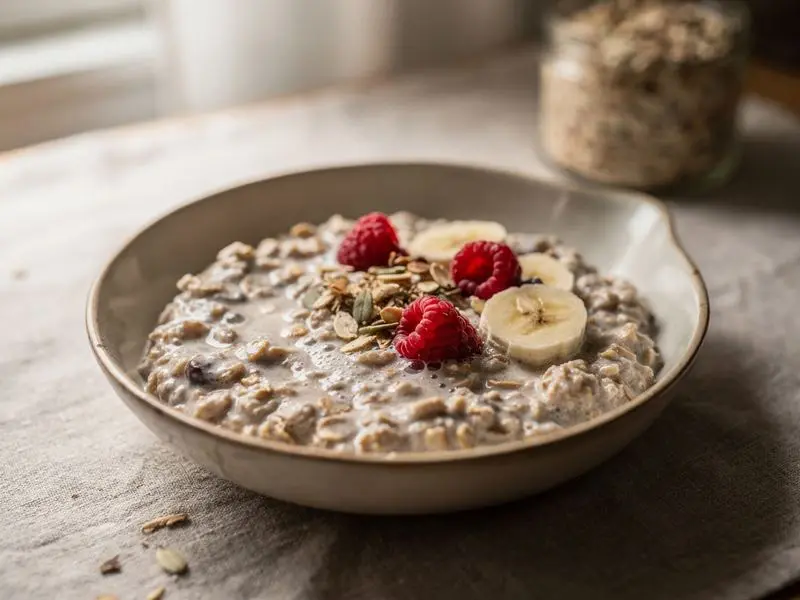
Bircher muesli is the original Swiss make-ahead breakfast: old-fashioned rolled oats softened in water with lemon juice, a grated apple folded through, then plain yogurt, milk and honey. It takes about 15 minutes at night and nothing on the stove; by morning, after at least 4 hours in the fridge, the oats have plumped into a creamy, spoonable bowl that needs only toasted almonds and a second apple on top. Swiss physician Maximilian Bircher-Benner created it around 1900 for patients at his Zurich sanatorium, and the method has barely changed since.
- Prep
- 15 min
- Cook
- 0 min
- Total
- 255 min
- Additional time
- 240 min
- Serves
- 4
Ingredients
What you’ll need — tap to tick off as you go
- 200 g
- 200 ml
- 1 tbsp
- 200 g
- 200 ml
- 2 tbsp
- 50 g
- 50 g
- 1 pinch
Process
Timers built in · swap anything · ask as you cook
In a large bowl, stir the 200 g rolled oats, 200 ml water and 1 tbsp lemon juice together until every oat is wet, then leave the bowl to stand for 5 minutes. This head start lets the oats drink before the dairy arrives, so they soften evenly instead of clumping when they meet the yogurt.
Grate one of the apples, skin and all, straight into the bowl, then add the 200 g plain yogurt, 200 ml milk, 2 tbsp honey and 1 pinch of salt. Mix thoroughly until the apple strands separate and the mixture looks like a thick, creamy porridge; grate over the bowl so no juice is lost.
Cover the bowl and refrigerate overnight, or for at least 4 hours. The cold does two jobs here: it keeps the raw apple and dairy food-safe, and it gives the rolled oats the hours they need to swell and thicken the liquid into a spoonable muesli.
In the morning, stir the muesli well from the bottom. If it has set too thick to spoon, add a splash more milk and stir until it flows again — the oats keep drinking while they sit, so what looks loose at midnight can be stiff by breakfast.
Toast the 50 g almonds in a dry frying pan over medium heat for 2 to 3 minutes, shaking the pan often, until they smell nutty and turn a shade darker. Tip them onto a plate to cool, then chop roughly; once they start to color, they can scorch in seconds.
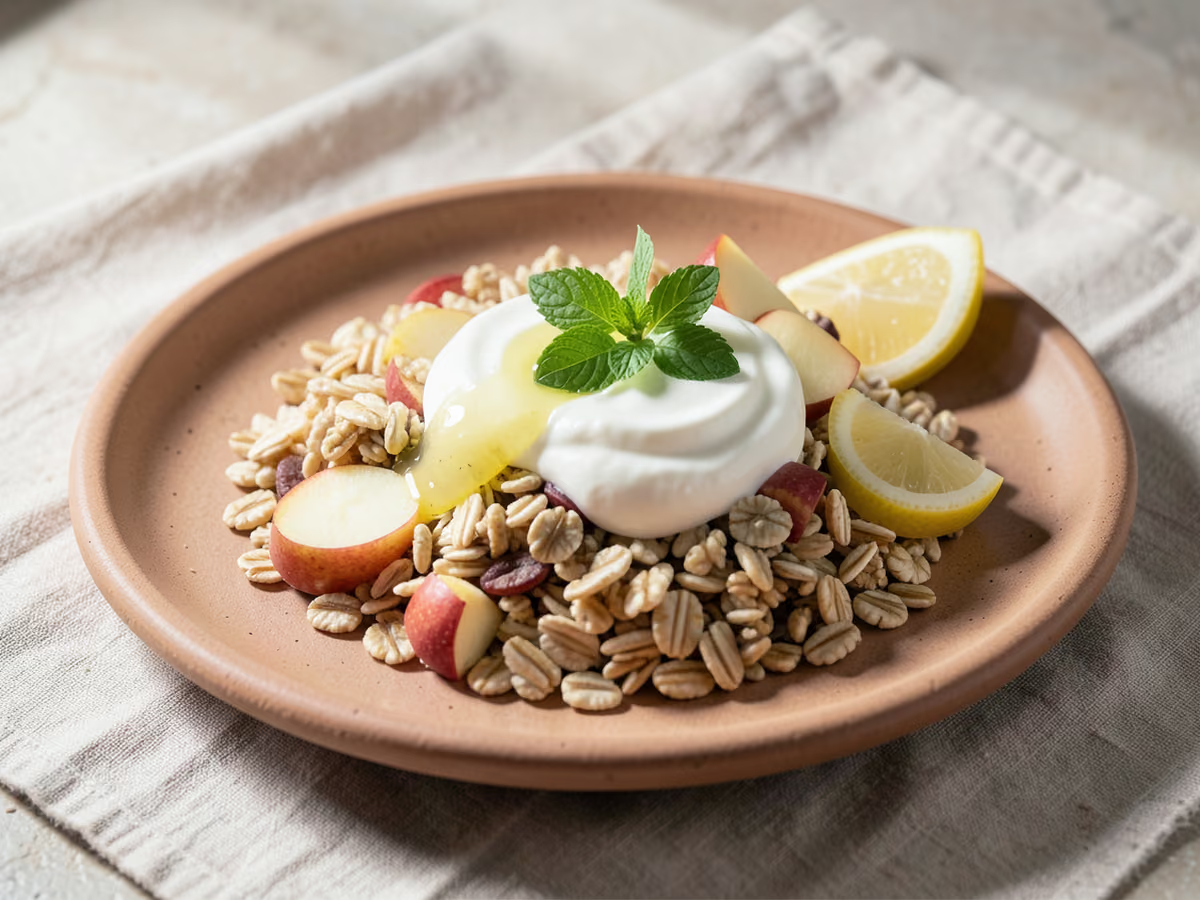
Serve the muesli into bowls and top each portion at the table with the remaining apple — grated or thinly sliced — the toasted almonds and the 50 g raisins if using; added last, the nuts stay crunchy and the second apple tastes freshly cut.
Why this recipe works
The oats need no heat because rolled oats are steamed and flattened during milling: soaked in liquid, they swell and soften on their own, keeping a little chew instead of collapsing into paste. The water and lemon juice go in first so the grains hydrate before the dairy thickens the mix, and the acid works on two fronts — it slows the enzyme that browns the grated apple and sharpens the sweet, oaty base. Folded in raw, the apple releases juice and pectin that give the muesli body, and the overnight chill keeps the raw fruit and dairy food-safe while the flavors blend.
Equipment
- Large mixing bowl, about 2 liters, deep enough to stir the oats without splashing
- Box grater, for the apples
- Measuring cups and spoons
- Wooden spoon or whisk, for folding the apple and yogurt through
- Airtight container or a bowl with a lid, for the overnight soak
- Small dry frying pan, for toasting the almonds
- Chef's knife and cutting board, for the second apple at serving time
- Four bowls or jars, and a small dish for the toppings
Kitchen notes
Kitchen notes
- Grate the second apple over the serving bowls at the table rather than into the overnight mix: it keeps the topping crisp and pale against the soft, mellow base — two apple textures in one bowl.
- Toast more almonds than you need for one batch and keep them in a jar; the 50 g this recipe calls for disappears fast, and having crunchy topping ready turns the next soak into two minutes of assembly.
- Check that the bowl feels properly cold before bed: a soak that starts warm can turn sour and faintly fizzy by morning, and there is no rescuing that batch. Mix it, lid it, fridge it — no time on the counter.
- Crush a few of the toasted almonds to a coarse powder and stir them through at serving: they thicken the muesli a little and carry the nut flavor into every spoonful, while the rest stay chunky for crunch.
- Taste before topping. Cold muesli straight from the fridge reads less sweet than it will at room temperature, so give a bowl five minutes on the counter and taste again before deciding about extra honey.
Common mistakes
- Mushy, paste-like muesli: quick or instant oats, or a bowl left soaking at room temperature. Use the 200 g of old-fashioned rolled oats, keep the bowl in the fridge from the first hour, and eat within 3 days; the grains should soften but still show their shape.
- Gray, tired-looking apple: the grated apple went in without enough acid, or it sat uncovered. Stir the lemon juice in before the apple meets the bowl, grate straight into the mix, and press a piece of plastic wrap onto the surface if it will sit overnight.
- Flat, one-note flavor: the pinch of salt skipped, an underripe apple, or too little honey. The salt is not seasoning — it makes the oats and apple taste sweeter and more themselves — and a crisp, sweet-tart apple carries the whole bowl.
- Scorched almonds: a pan that was too hot, or almonds left unattended for one minute too long. Toast them over medium heat for 2 to 3 minutes, shaking the pan, and pull them the moment they smell nutty and darken just a shade; bitter almonds cannot be rescued.
- A stiff, dry bowl by the second morning: the oats kept drinking and it sat too long. Stir in a splash more milk before serving and eat it within the 3-day window; the texture should stay creamy and spoonable, not set like porridge left to cool.
Serving suggestions
- Serve cold straight from the fridge in shallow bowls, so the toppings sit on the surface and every spoonful gets some crunch.
- A breakfast by modern habit, but the original sanatorium served it as an evening dish, and it is substantial enough to stand alone as a light supper.
- Set out small dishes of the toasted almonds, raisins and extra apple and let everyone finish their own bowl at the table; a spoonful of yogurt on top is welcome if the morning bowl looks plain.
- Coffee or strong black tea alongside is the classic pairing; keep drinks simple so the lemon and apple stay the loudest notes in the bowl.
Variations
- Sanatorium original: soak the oats overnight in the water, then stir in sweetened condensed milk and lemon juice and grate a whole apple in while stirring, topping with chopped nuts — the 1900 formula, sweeter and more apple-forward than the modern yogurt bowl.
- Dairy-free version: use a plant-based yogurt and plant milk, the same 200 g and 200 ml, and maple syrup in place of the honey. The bowl is lighter and tangier; a spoon of nut butter stirred through brings back the richness the dairy would have given.
- Autumn version: two ripe pears grated in place of the apples, with a pinch of cinnamon, is a Swiss favorite once the apple crop is past its best.
Refrigerator
- RefrigeratorAirtight in the fridge, the muesli is best on day one and stays good for up to 3 days. Keep the toasted almonds and the serving apple separate until you eat, stir before serving, and loosen with a splash of milk if it has set thick. Do not leave it at room temperature for more than 2 hours.
- ReheatingNone. Bircher muesli is a cold dish and warming it makes the yogurt grain and the texture collapse. If you want a hot oat breakfast, cook rolled oats instead.
- FreezingNot recommended: the soaked oats turn mushy and the yogurt splits on thawing, and the fresh apple and lemon are the first things to fade. This is a two-minute mix to start over, so make it fresh.
- Make aheadThis is the make-ahead breakfast by design: mix the bowl the night before, chill at least 4 hours, and finish it in the morning with the second apple and the almonds. Jar it in portions if mornings are rushed; the base holds 3 days in the fridge, softening a little each day.
Updated:
How this recipe was developed
- SWI swissinfo.ch, 'Birchermüesli: from cure to cult' (Maximilian Oskar Bircher-Benner's Zurich sanatorium; original recipe soaks rolled oats in water, then adds condensed milk, lemon juice, a whole grated apple and chopped nuts)
- About Switzerland, the Swiss federal EDA portal, 'Muesli: the world-famous Swiss breakfast classic' (apple diet dish developed around 1900; Müesli is the Swiss German diminutive of mash; yogurt and milk later replaced condensed milk)
- Coeliac UK, 'Oats and the gluten free diet' (oats contain avenin and are widely cross-contaminated with wheat, barley and rye; only oats labeled gluten free are suitable)
- USDA FSIS, 'Leftovers and Food Safety' (refrigerate prepared food within 2 hours; keep leftovers 3 to 4 days in the fridge)
Editorial references are kept internally for verification. This page makes no claim of external certification or professional testing.
FAQ
The questions we get asked most
What is Bircher muesli?
A Swiss breakfast of rolled oats soaked overnight with water and lemon juice, then mixed with grated apple, dairy and nuts. The physician Maximilian Bircher-Benner created it around 1900 as a raw-food dish for patients at his Zurich clinic, and it was first called the apple diet dish because the grated apple, not the oats, was the main ingredient. This version keeps the spirit of the original: no cooking, an overnight soak, fresh apple, toasted almonds and just enough yogurt, milk and honey to make it creamy. Whole-grain oats and fruit bring fiber, the yogurt and nuts bring protein and fat, and the honey is the main added sugar.
What's the difference between Bircher muesli and overnight oats?
Bircher muesli is the original: a Swiss physician's recipe from around 1900 that always includes fresh grated apple, lemon juice and nuts alongside the soaked oats. Overnight oats are the modern, looser family that grew out of it — the same soak-and-chill idea, but built on yogurt, milk, chia or seeds with no fixed formula, and often no grated apple at all. If a chilled bowl tastes bright and appley, it is closer to Bircher muesli; if it is creamy and neutral, it is closer to plain overnight oats. Both are made ahead and eaten cold.
Is Bircher muesli the same as regular muesli?
No, and the difference shows at the table. Regular muesli is the dry boxed mix of rolled oats, dried fruit and nuts that stays crunchy and is eaten with cold milk poured over. Bircher muesli is a prepared dish: the oats are soaked overnight until they soften, and fresh grated apple, lemon juice, yogurt and milk are worked through, so it eats like a creamy porridge rather than a cereal. Cafes use the Bircher name to signal the made-fresh version rather than a bowl of packet muesli.
Where does Bircher muesli come from?
From Zurich, Switzerland, around 1900. The physician Maximilian Bircher-Benner developed it as the apple diet dish for patients at his sanatorium in the hills above Lake Zurich, where fresh fruit, nuts and raw food were central to the treatment. His formula combined soaked rolled oats, lemon juice, sweetened condensed milk, a whole grated apple and chopped nuts, and it spread from the clinic into Swiss homes and institutions before conquering breakfast tables worldwide. The name is Swiss German: Müesli is a diminutive of mash, so Birchermüesli means roughly the doctor's little mush.
Why is my Bircher muesli too thick?
Because the oats keep absorbing liquid after the first soak. A bowl that looked loose at midnight can be stiff by morning, and two or three days in the fridge sets it further. Stir in more milk, a splash at a time, until it flows again; the texture should be creamy and spoonable, not pourable. If it was stiff from the start, the water and milk were probably under-measured, or quick oats were used, which drink faster than the rolled oats this recipe calls for.
How long does Bircher muesli last in the fridge?
Covered and kept cold, up to 3 days. It is at its best on day one, when the oats are softened but still have some bite and the apple is bright; after that the texture relaxes and the lemon fades, though it stays safe to eat within that window. Leave the almonds and the serving apple out until you eat, stir in a splash of milk before serving, because the mix tightens as it sits, and do not leave it at room temperature for more than 2 hours.
Is Bircher muesli gluten-free?
Only if you use gluten-free oats. Oats themselves contain no gluten, but they are commonly grown and milled alongside wheat, barley and rye, which contaminates them, so standard oats are not safe on a gluten-free diet. Oats also carry a protein called avenin that a small number of people with coeliac disease react to. Buy oats labeled gluten free, keep the rest of the recipe as written — yogurt, milk, honey and nuts are all naturally gluten-free — and check the packets of the nuts and dried fruit for gluten warnings.
Ask KitchenMind about this recipe
Tell it what’s different tonight — it works within the actual recipe.