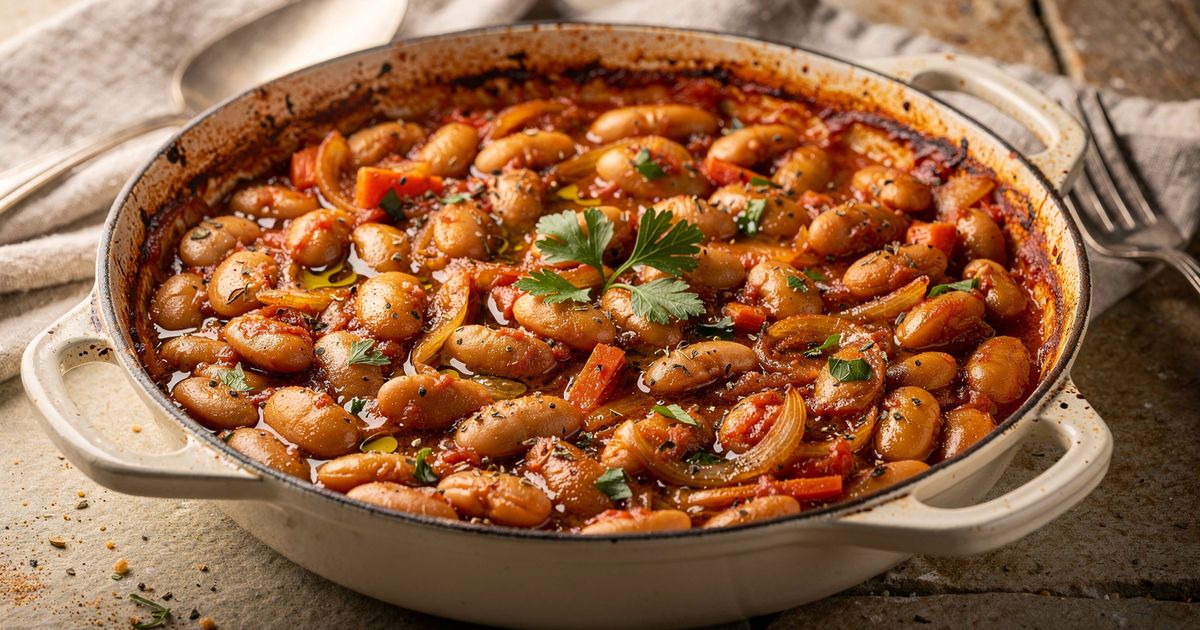
Gigantes Plaki Baked Beans
Gigantes plaki is Greece's answer to baked beans: giant butter beans simmered until creamy, then baked in a tomato sauce built on sweet onions, garlic, oregano and a generous pour of olive oil. The beans need an overnight soak and 45 to 50 minutes of simmering before they meet the oven, and then 45 to 50 minutes of baking does the rest — 20 minutes of prep and 90 minutes of cooking, most of it hands-off. The result tastes far richer than its ingredients suggest, and better again the next day.
- Prep
- 20 min
- Cook
- 90 min
- Total
- 590 min
- Additional time
- 480 min
- Serves
- 6
Ingredients
What you’ll need — tap to tick off as you go
- 500 g
- 120 ml
- 4 cloves
- 2 tbsp
- 400 g
- 1 tsp
- ½ tsp
- 500 ml
- 1 tsp
- ½ tsp
- ¼ cups
Process
Timers built in · swap anything · ask as you cook
Drain the soaked 500 g beans and put them in a large pot with fresh water to cover by about 5 cm. Bring to a full boil over high heat, then turn down and simmer for 45 to 50 minutes, until a bean crushes easily against the side of the pot under light pressure but still holds its shape. Drain and set aside.
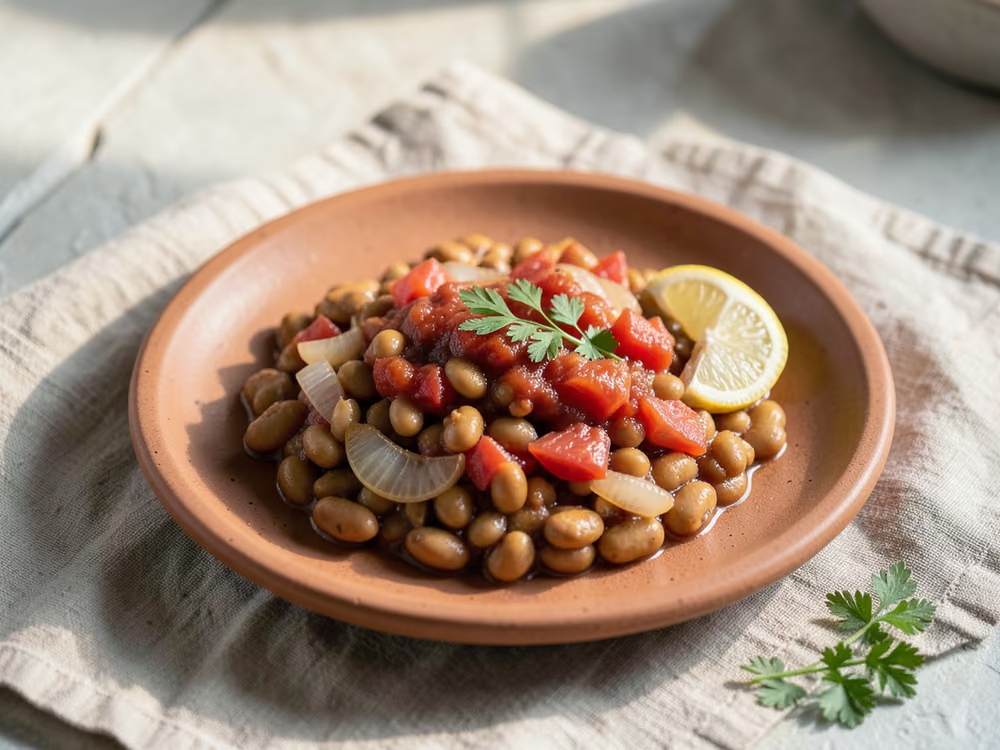
Heat the oven to 180°C while the beans cook, and give it time to reach temperature rather than trusting the dial: an oven that is still climbing when the pan goes in is one of the reasons a plaki comes out watery, because the sauce needs real heat to reduce.
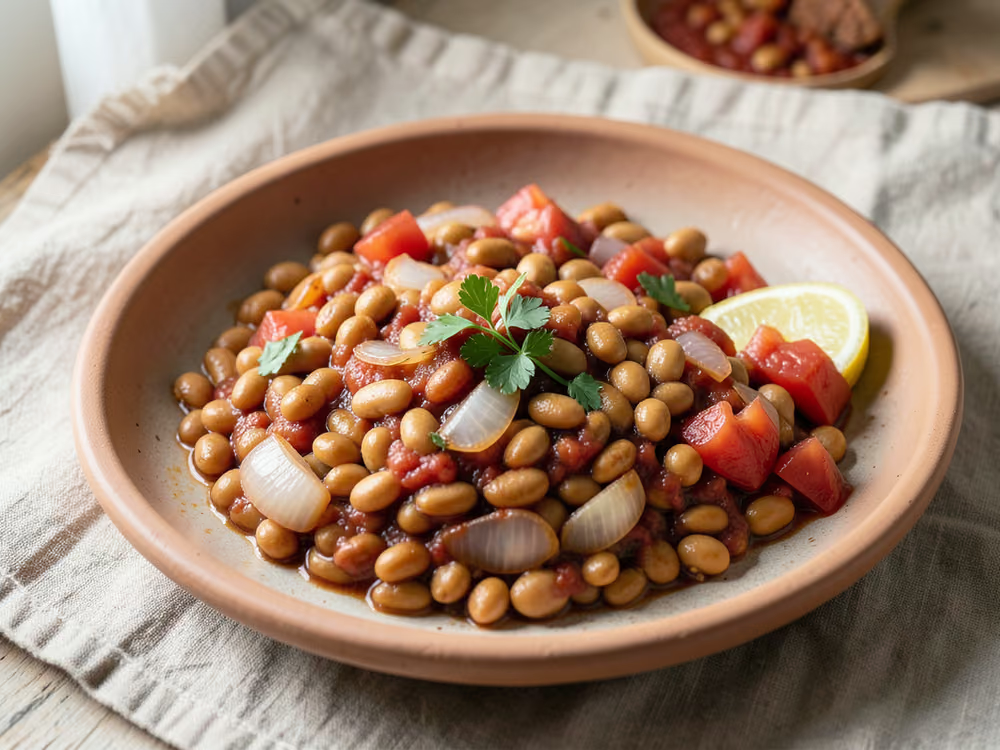
In a large ovenproof skillet or Dutch oven, warm the 120 ml olive oil over medium heat, add the 2 finely chopped onions and cook for 8 to 10 minutes, stirring occasionally, until soft, translucent and just starting to turn golden at the edges. Sweating them slowly builds sweetness; browning them hard makes the sauce taste bitter.
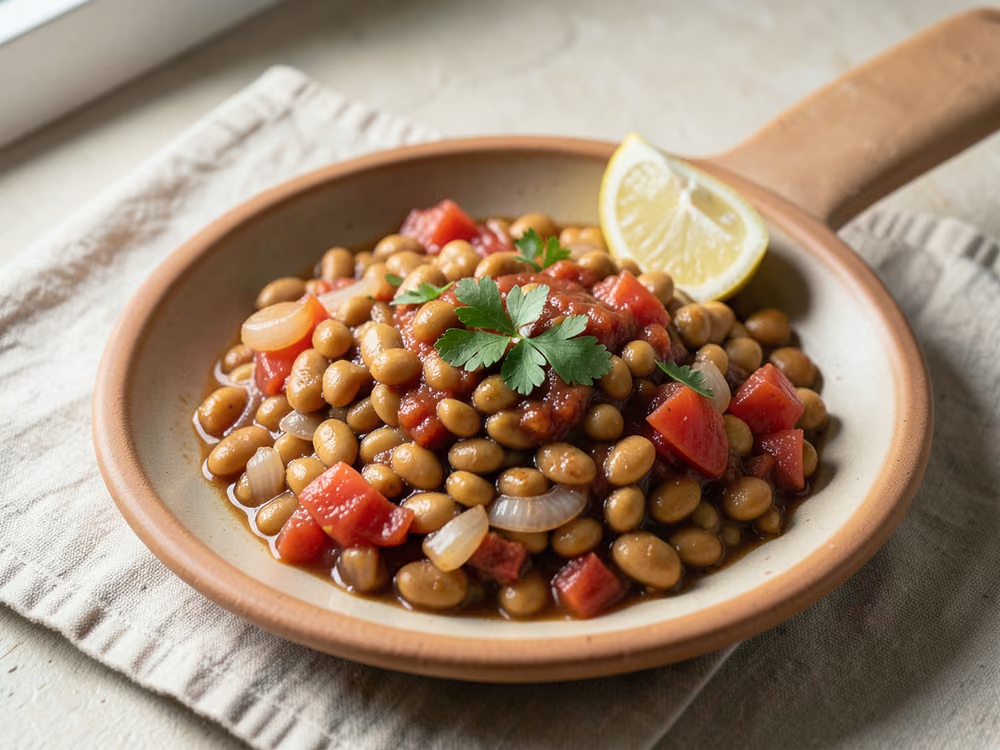
Add the 4 minced garlic cloves and cook for 1 minute, stirring, until fragrant. Garlic goes from sweet to scorched fast at this heat, and burnt garlic turns the whole pot bitter — nothing later can undo it.
Stir in the 2 tbsp tomato paste and fry it for 2 minutes, stirring constantly, until it darkens from bright red to a deep brick colour. This is the step that turns tinned paste into a savoury base; skip it and the sauce stays thin and sharp.
Add the 400 g canned chopped tomatoes, 1 tsp dried oregano, 0.5 tsp dried thyme, 2 bay leaves, 1 tsp salt and 0.5 tsp black pepper. Stir well and let the sauce come to a gentle simmer for 2 to 3 minutes so the dried herbs start releasing their flavour.
Pour in the 500 ml hot vegetable broth and bring it back to a bare simmer. Hot liquid matters: cold water poured into a hot bean pot makes the skins split, so keep the broth hot until the moment it goes in.
Add the drained beans and stir gently with a spatula to coat them. Treat the beans like dumplings from here on: a few slow folds, without scraping the bottom hard, because broken beans turn the dish into puree.
Move the pan to the oven, uncovered, and bake for 45 to 50 minutes, stirring once at the halfway point. The open pan is what reduces the sauce to a glaze; if the top starts catching before the beans are creamy, lay a sheet of foil loosely over the pan for the last 15 minutes.
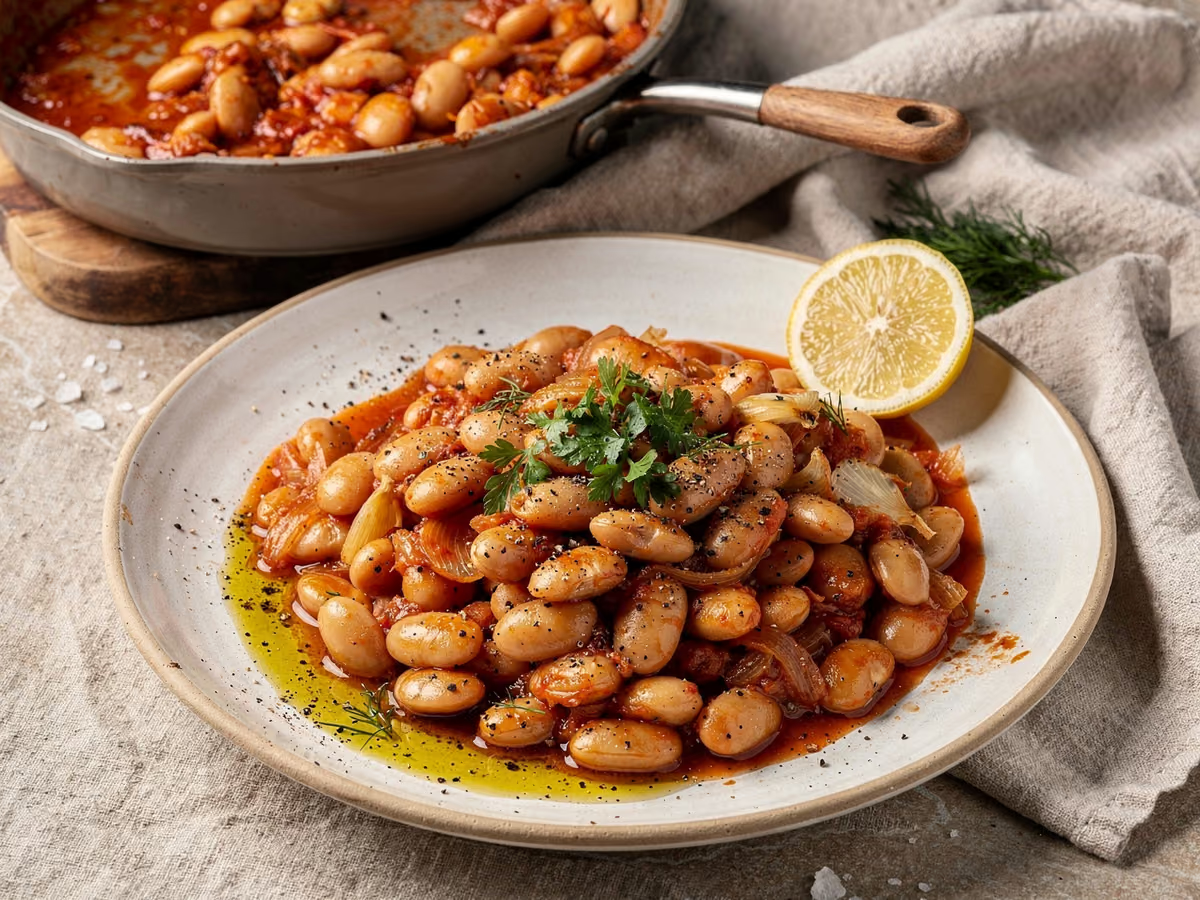
Take the pan out and let it rest for 10 minutes — the sauce tightens as it stands. Discard the 2 bay leaves, taste and adjust the salt, then scatter over the 0.25 cup chopped fresh parsley and drizzle with a little more olive oil before serving.
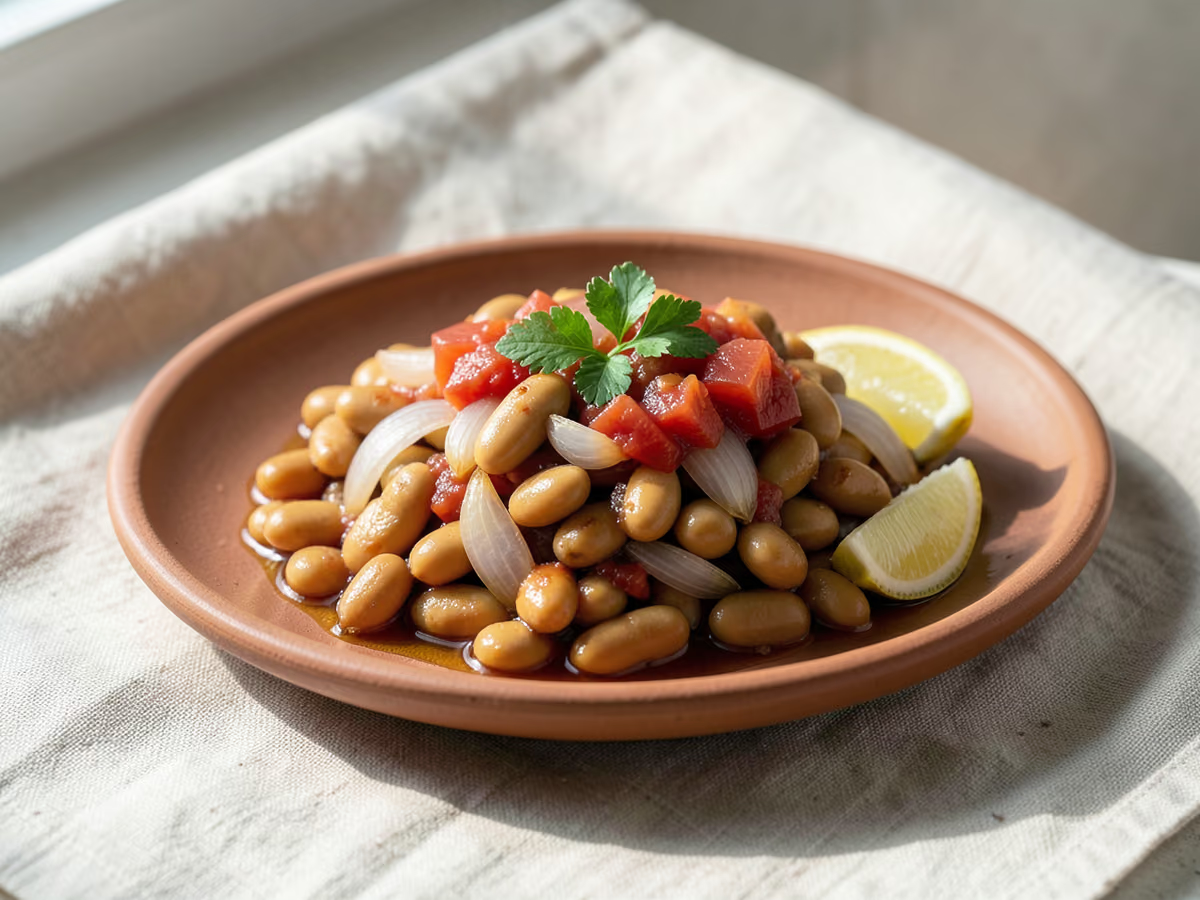
Why this recipe works
Dried beans are mostly starch, and starch needs water and time to soften: the overnight soak hydrates them so they cook evenly, and the simmer finishes the job before the oven, because in the acidic tomato sauce they firm up rather than soften further. The sauce is built in stages — onions sweated sweet, tomato paste fried until it darkens — and the uncovered bake then reduces it to a glaze. The generous olive oil and the starch the beans release give the finished dish its glossy, almost creamy body.
Equipment
- Large pot, at least 4 litres, for soaking and simmering the beans
- Colander
- Large ovenproof skillet or Dutch oven that holds the beans in a single layer
- Chef's knife and cutting board
- Wooden spoon plus a heatproof spatula for the gentle stir
- Measuring jug and measuring spoons
- Sheet of foil for the last stretch of baking, and oven mitts
Kitchen notes
Kitchen notes
- The 10-minute rest earns its place: the sauce thickens as it cools, and beans pulled straight from the oven taste thinner than they do five minutes later. It also makes them easier to serve without breaking.
- Judge the beans by pressing one against the side of the pot with a spoon, not by the clock: when it slips apart easily and the skin stays whole, they are ready for the oven. Older dried beans genuinely can take 70 minutes.
- The 120 ml of olive oil is the recipe, not a misprint. It works into the sauce and carries the oregano; cut it hard and the beans taste stewed rather than baked, and the finish tastes flat.
- A day in the fridge works wonders: like most bean dishes, plaki is better on day 2, once the beans have drunk the sauce. Cook it ahead if you can, cool it fast and reheat gently.
- No ovenproof pan? Build the sauce in a regular skillet, tip the beans and sauce into a wide baking dish, and bake as written — a shallow layer is what lets the sauce reduce to a glaze.
Common mistakes
- Hard beans even after baking: they were undercooked before the oven, and the acidic tomato sauce firms skins rather than softening them. Simmer until a bean crushes easily, the full 45 to 50 minutes, and only then let it meet the sauce.
- A dry, pasty pan: too little liquid, or too long an uncovered bake. Start with the full 500 ml of hot broth, check at the halfway stir, and add 100 ml of hot water if the pan looks dry.
- Beans broken into mush: stirring hard or too often. Stir once at the halfway point with a spatula and leave the pan alone otherwise; the beans are already soft and only need the sauce around them.
- A scorched top with firm beans underneath: the oven ran hot or the pan was too shallow, so the surface dried out first. Keep to 180°C, and lay foil over the pan if the top starts catching.
- Bland, flat plaki: under-salting and skimping on the oil. The dish is seasoned through the sauce, so taste it after baking and finish with a raw drizzle of olive oil and a pinch more salt.
- Split bean skins during the boil: cold liquid poured into the hot pot. Top up and loosen with hot water only, and keep the pot at a steady simmer rather than a rolling boil.
Serving suggestions
- Serve warm or at room temperature as a meze, straight from the pan, with crusty bread to mop the oil — 6 portions as a side or shared starter.
- Feta, olives and a sharp tomato-cucumber salad alongside; the acidity cuts the richness of the oil beautifully.
- As a main course, spoon it over rice or top each portion with a fried egg; the sauce is good enough to soak into both.
- Sparkling water, iced tea or a cinnamon punch to drink; the dish is rich, so nothing sweet goes with it.
Variations
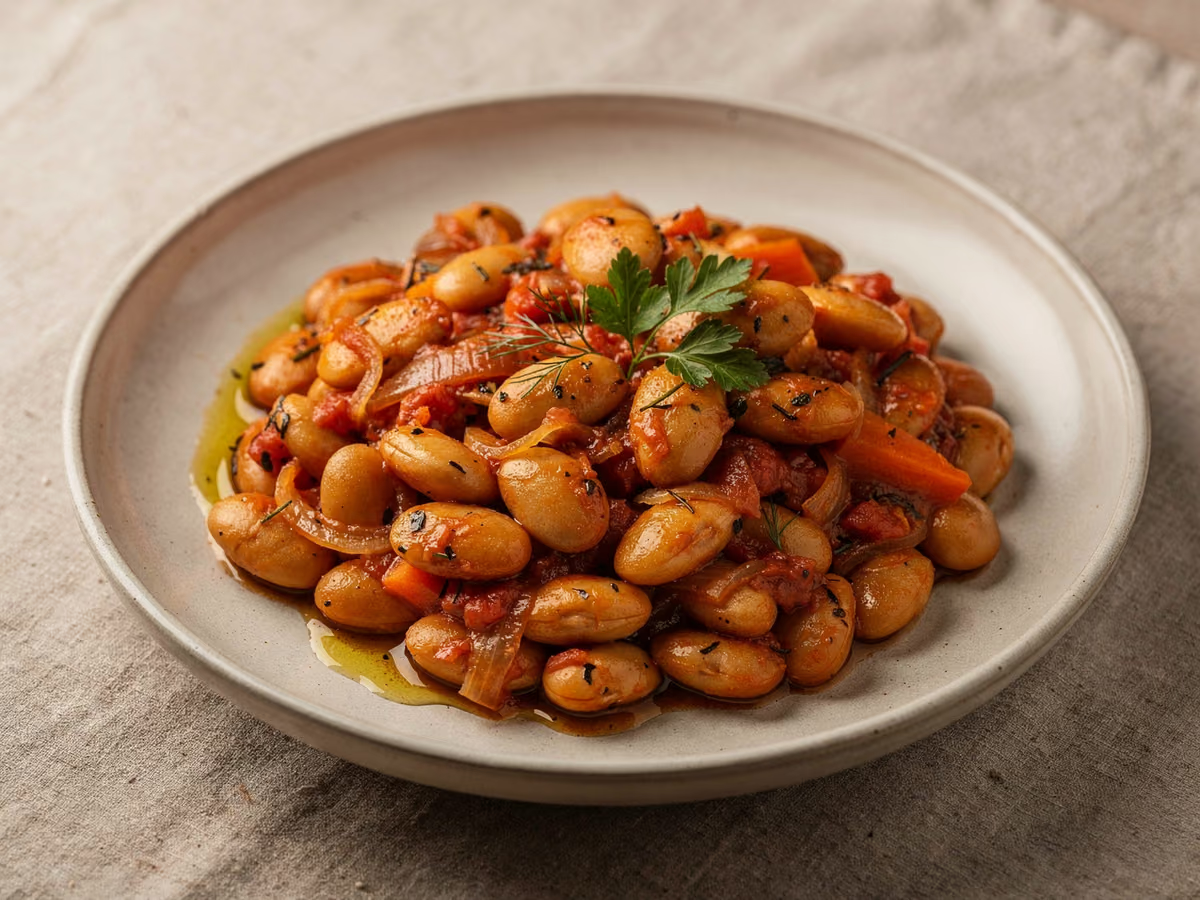
- Extra vegetables: add 1 diced carrot and 1 diced celery stalk with the onions, or a diced red pepper. Keep any additions under 200 g in total so the sauce still thickens properly.
- A sharper finish: a splash of vinegar or lemon juice stirred in after baking, as some versions do, brightens a pot that tastes heavy. Add it a little at a time and taste as you go.
- Feta-baked, a different non-vegan version: crumble feta over the top for the last 10 minutes of baking, as one well-known family version does; the cheese melts into the sauce and adds salt, so season the base lightly.
Refrigerator
- RefrigeratorCool the pan within 2 hours of baking (USDA FSIS guidance), then refrigerate in an airtight container for up to 4 days. FSIS allows 3 to 4 days for refrigerated leftovers, so treat day 4 as the outer limit. The beans hold their shape well on reheating.
- ReheatingReheat covered on the stovetop over medium-low heat for 8 to 10 minutes, adding 2 to 3 tbsp water or broth if the sauce looks dry, or in a 160°C oven for 15 to 20 minutes, stirring once — until bubbling and at least 74°C inside (FSIS reheat guidance). Reheat only once, and do not refreeze.
- FreezingUp to 3 months: portion into freezer-safe containers with 2 cm headspace and thaw overnight in the fridge. FSIS gives frozen leftovers 3 to 4 months at best quality. Freeze after the first cooling, never after reheating.
- Make aheadThe beans and the sauce can be cooked up to 2 days ahead and kept separately in the fridge, then combined and baked for 45 to 50 minutes before serving — the split approach keeps the beans from drinking the sauce early. Baking the whole dish a day ahead also works: cool it fast, refrigerate, and reheat covered at 160°C for 25 minutes with a splash of broth.
Updated:
How this recipe was developed
- The Guardian, Felicity Cloake's perfect gigantes plaki — soak for 8 to 12 hours, simmer gently until just tender (45 minutes to an hour), bake at 180°C and balance the seasoning at the end
- Dimitra's Dishes, Greek gigantes baked giant bean casserole — soak overnight, boil about 40 minutes until tender but not mushy (they finish in the oven), bake uncovered about 45 minutes, and loosen with hot water if the sauce is absorbed
- Real Greek Recipes, Greek butter beans (gigantes plaki) — overnight soak of 8 to 12 hours, gentle simmer of 40 minutes to 1 hour (older beans take longer), and never cold water into the hot pot or the skins split
- USDA FSIS leftovers guidance — cool and refrigerate within 2 hours, 3 to 4 days in the fridge, reheat to 74°C, and 3 to 4 months in the freezer at best quality
Editorial references are kept internally for verification. This page makes no claim of external certification or professional testing.
Gallery
FAQ
The questions we get asked most
Why are my gigantes beans still hard after baking?
The beans were not fully tender before they went into the oven, and baking in an acidic tomato sauce firms their skins further rather than softening them. Next time simmer them until one crushes easily under light pressure, which can take 45 to 70 minutes depending on the age of the beans, and only then add them to the sauce.
Can I make this with canned beans instead of dried?
Yes. Use about 900 g of drained canned or jarred giant beans, skip the soaking and simmering, and reduce the salt to 0.5 tsp since canned beans are already salted. Bake for 25 to 30 minutes at 180°C, just until the sauce thickens, and rinse the beans well first.
Can I prepare gigantes plaki ahead of time?
Yes. Cook the beans and the sauce up to 2 days ahead and keep them in separate containers, so the beans keep their shape and the pan does not dry out; bake as written on the day. A fully baked dish can also be cooled, refrigerated overnight, and brought back in a covered 160°C oven for 25 minutes with a splash of broth.
How do I know when the dish is done?
The sauce should reduce to a thick, glossy coating that holds its shape when you pull a bean through it, and the beans should be creamy all the way through with no chalky centre. If the sauce still looks watery after 50 minutes, bake it 10 minutes longer uncovered; it will thicken further during the 10-minute rest.
Why did my baked beans turn out dry or pasty?
Too little liquid or too long an uncovered bake. The beans absorb broth as they bake, so start with the full 500 ml of hot broth, check at the halfway stir, and add 100 ml of hot water if the pan looks dry. Keep the oven at 180°C, since higher heat drives off moisture too fast.
Can I use frozen giant beans or add other vegetables?
Frozen cooked giant beans work well: thaw 700 g, skip the boiling, and bake 30 to 35 minutes. For vegetables, add 1 diced carrot and 1 diced celery stalk with the onions, or a diced red pepper, but keep total added vegetables under 200 g so the sauce still thickens properly.
Should I salt the water when I cook dried beans?
Cooks genuinely disagree, and this recipe sidesteps the argument: it keeps the bean pot unsalted and puts 1 tsp of salt into the sauce instead, then checks the seasoning after baking. If you prefer to salt the soaking water, as several well-known versions do, hold back a little of the sauce salt and taste at the end.
Ask KitchenMind about this recipe
Tell it what’s different tonight — it works within the actual recipe.