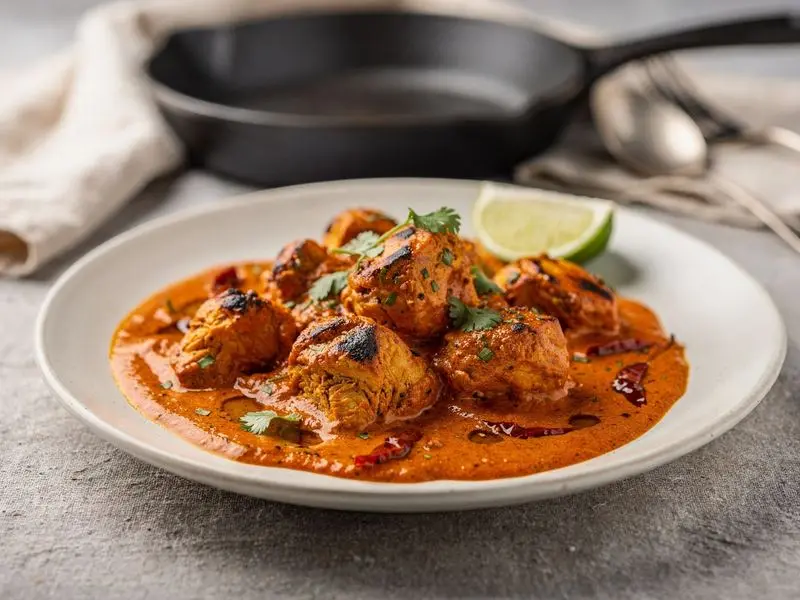
Lamb Rogan Josh
Rogan josh is the defining red curry of Kashmir: 1 kg of lamb shoulder marinated in spiced yogurt, seared in ghee with whole warm spices, then simmered low for 1.5 to 2 hours in a tomato and yogurt gravy until the meat gives way to a fork. The long braise is almost entirely hands-off — 20 minutes of prep buys a pot that tastes even better the next day — and the deep colour comes from the chili and tomato rather than any last-minute fuss. Serve it over basmati rice, with naan for scooping.
- Prep
- 20 min
- Cook
- 90 min
- Total
- 230 min
- Additional time
- 120 min
- Serves
- 6
Ingredients
What you’ll need — tap to tick off as you go
- 1 kg
- 200 g
- 6 cloves
- 2 tbsp
- 400 g
- 3 tbsp
- 1 tsp
- 1 tsp
- 2 tbsp
- 1 tsp
- 2 tsp
- 1 tsp
- 250 ml
- 2 tbsp
Process
Timers built in · swap anything · ask as you cook
In a large bowl, mix the 1 kg lamb cubes with the 200 g whisked yogurt, half of the minced garlic, half of the grated ginger and 1 tsp of the salt. Cover and refrigerate for at least 2 hours, or overnight if you can; the yogurt's gentle acidity works on the surface of the meat, so every hour adds seasoning and tenderness.
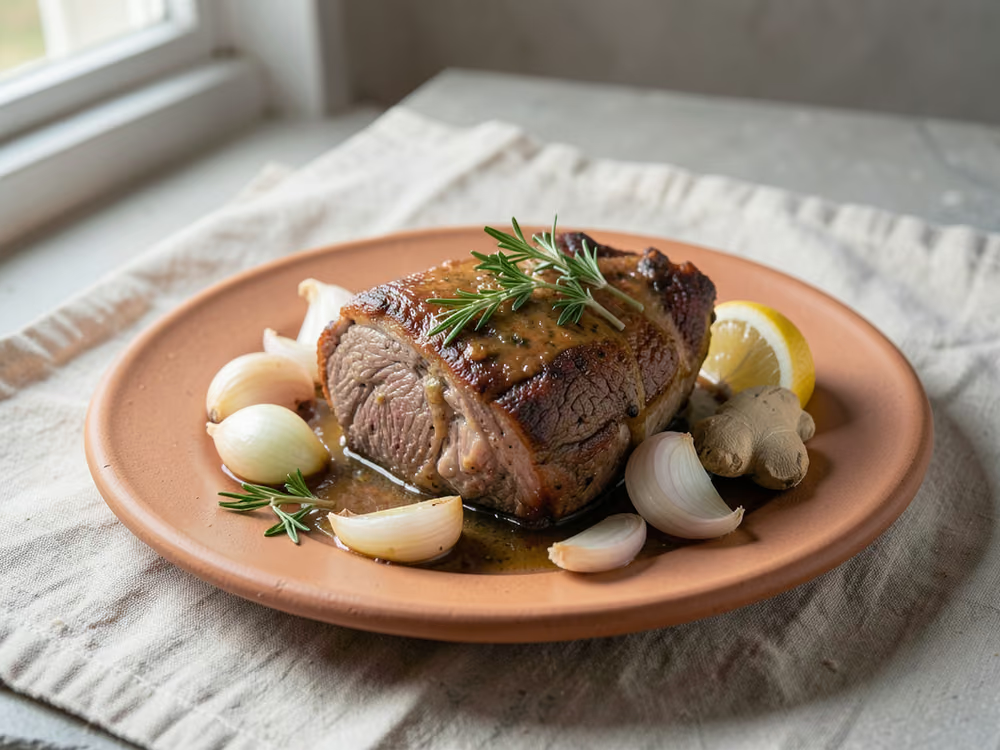
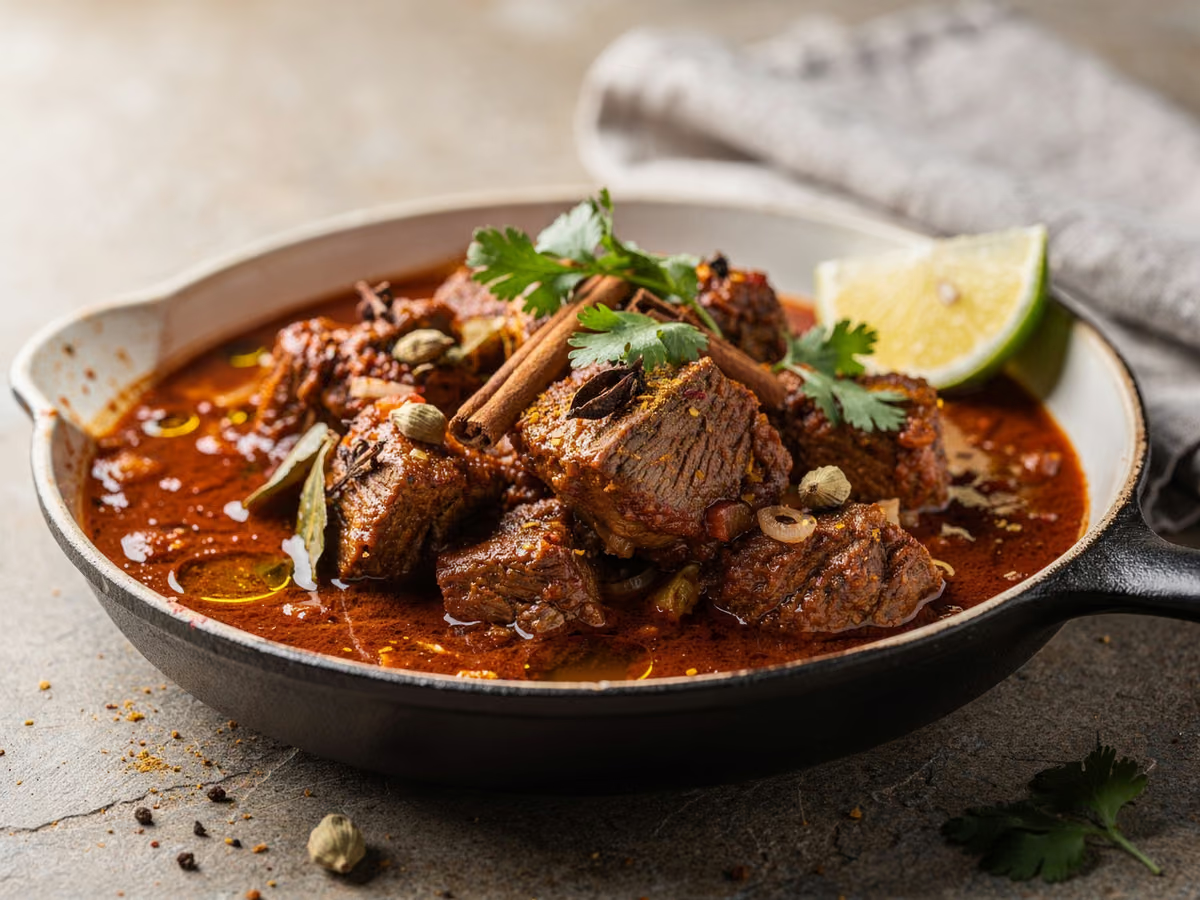
Heat the 3 tbsp ghee in a heavy pot over medium heat. Add the 2 bay leaves, the cinnamon stick, 6 lightly crushed cardamom pods, 4 cloves, 1 tsp black peppercorns and 1 tsp cumin seeds, and fry for 30 seconds, until the seeds sizzle and the pot smells warm and sweet. Blooming whole spices in fat is where the fragrance is built; any longer and they turn acrid.
Add the 2 finely chopped onions and cook, stirring occasionally, for 8 to 10 minutes, until they are golden brown, soft and glossy. This is not a stage to rush: the onions' colour becomes the sauce's flavour, and a half-browned onion leaves the finished gravy thin and flat.
Add the remaining minced garlic and grated ginger and cook for 1 minute, until the raw smell disappears and the mixture turns fragrant. Garlic at this stage goes from sweet to bitter quickly, so keep it moving and keep the heat moderate.
Reduce the heat to low and stir in the 2 tbsp coriander powder, 1 tsp turmeric and 2 tsp red chili powder. Stir for 30 seconds, just until the spices darken slightly and smell toasted; ground spices go from fragrant to bitter in under a minute at this heat, so keep them moving.
Add the 400 g tomato purée and cook for 5 minutes, stirring frequently, until the oil separates and glistens at the edges of the masala and the sauce thickens and darkens towards brick red. This step decides the finished gravy: the water leaves, the flavour concentrates, and the sauce stops tasting raw.
Add the marinated lamb with all of its marinade and stir well to coat every piece. Cook over medium heat for 5 to 7 minutes, turning the pieces, until they are browned on all sides. Keep the heat at medium — a hard boil at this point is what makes yogurt split — and let the lamb take on colour before any liquid goes in.
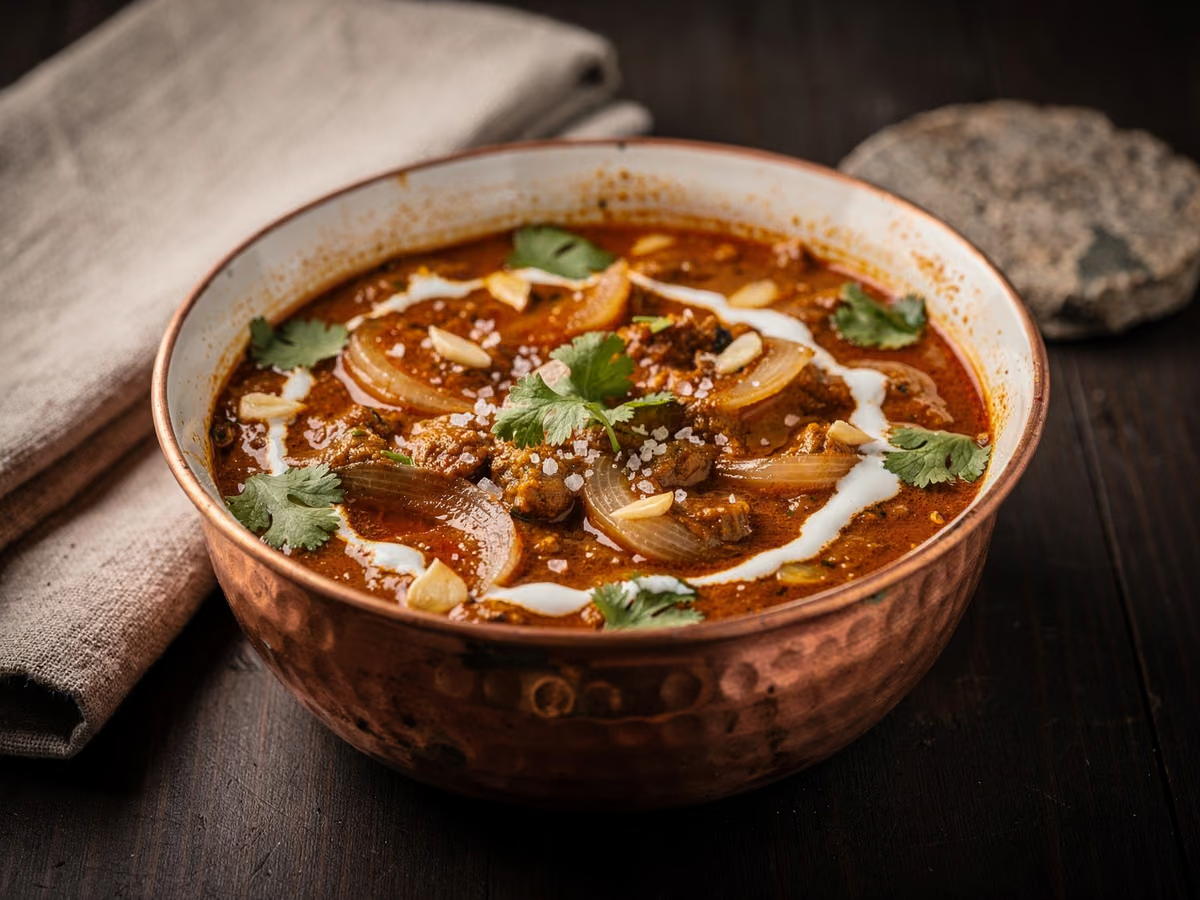
Pour in the 250 ml hot water, bring to a bare simmer, then reduce the heat to low, cover, and cook for 1.5 to 2 hours, until the lamb is fork-tender and the sauce has thickened. Stir every 15 minutes or so and add hot water — never cold — a splash at a time if the pot looks dry.
Taste and adjust the salt, then spoon off any fat pooling on the surface if you prefer a leaner sauce. Scatter over the 2 tbsp chopped cilantro and serve, or cool and refrigerate for a day — like most braises, rogan josh is even better on the second day.
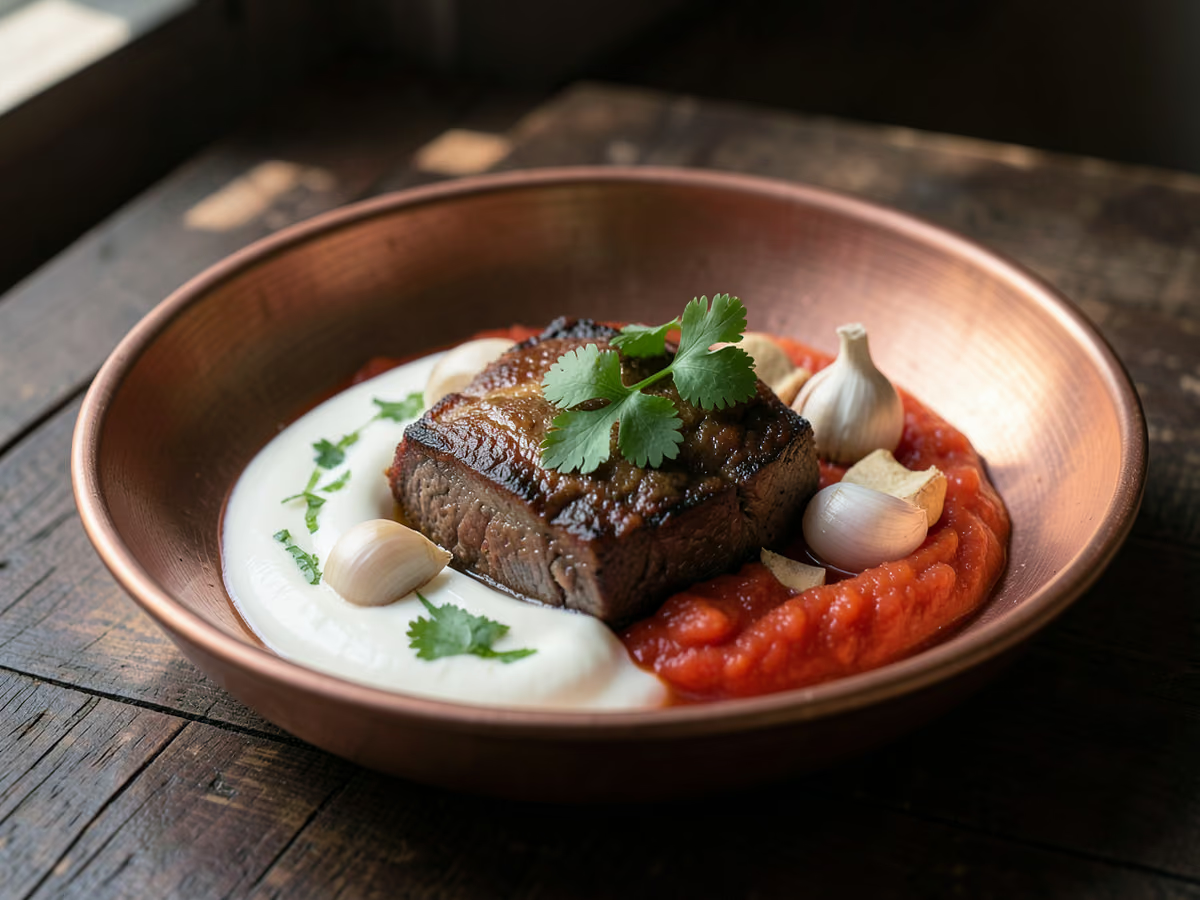
Why this recipe works
Three stages decide the pot. Whole spices bloomed in hot ghee release their fat-soluble aromatics immediately, and the onions fried to gold in that same fat become the sauce's sweetness and body. The tomato purée is then cooked until the oil separates — the stage worth waiting for, because driving off water there concentrates and darkens the sauce instead of leaving it raw and sharp. Finally, a bare simmer: yogurt stays smooth below a boil, and 1.5 to 2 hours of gentle heat lets the lamb shoulder's collagen melt into gelatin, which is what thickens the gravy and turns the meat fork-tender instead of stringy.
Equipment
- Heavy-bottomed pot or Dutch oven, 4 to 5 litres, with a lid
- Wooden spoon or heatproof spatula
- Chef's knife and cutting board
- Small bowl for the yogurt marinade
- Measuring spoons
- Mortar and pestle, or the flat of a knife, for lightly crushing the cardamom pods
- Instant-read thermometer
- Ladle
Kitchen notes
Kitchen notes
- Marinate overnight when you can. The yogurt seasons the lamb through and does gentle tenderising work as it sits, and the spiced marinade becomes part of the sauce, so nothing is wasted.
- Wait for properly golden onions — 8 to 10 minutes is not too long. Their colour is the gravy's depth, and rushing this stage is the most common reason a home rogan josh tastes thin.
- Bone-in shoulder, cut by your butcher, adds gelatin, marrow and body as it simmers; with boneless cubes, expect to simmer a little longer or to finish the sauce with the lid off.
- Keep hot water by the kettle. Cold water shocks the simmer and can tighten the meat; adding hot water keeps the temperature steady and the sauce silky.
- Traditional Kashmiri versions build the gravy from yogurt, whole spices and ginger, without onion or tomato; this recipe keeps the onion and purée for a fuller, more approachable sauce, and the oil-separation wait is what keeps the result close to the classic.
- Skim with judgment: rogan josh is meant to be rich, but if a pool of fat gathers on top, spoon some of it off before serving — the finished dish should wear a sheen, not a slick.
Common mistakes
- Watery gravy: the tomato stage was rushed or the pot simmered covered the whole time. Cook the purée until the oil visibly separates, and in the last 30 minutes leave the lid off so the sauce can reduce; if it is still thin, simmer uncovered for 10 to 15 minutes more.
- Curdled, grainy yogurt: cold yogurt met a hot pan, or the pot boiled after the marinade went in. Use room-temperature yogurt, whisk it smooth, keep the heat at medium when the lamb goes in, and hold a bare simmer from then on.
- Tough, stringy lamb: too little time, a furiously boiling pot, or the wrong cut. Shoulder wants 1.5 to 2 hours at a bare simmer; check every 15 minutes past 1.5 hours and add hot water whenever the sauce tightens.
- Raw, flat-tasting sauce: the ground spices were never toasted, or the purée never cooked down. Give the spices their 30 seconds in the fat and the tomato its full 5 minutes to the oil-separation point — those two stages carry the whole dish.
- Bitter, scorched masala: ground spices held too long over heat. Toast them for 30 seconds at low heat only, stirring continuously, and if they do catch, start the sauce stage over rather than trying to dilute the bitterness.
- Dull flavour despite good spice: not enough salt, or served too soon after cooking. Yogurt and tomatoes swallow a lot of salt, so season at the end, and let the pot rest off the heat for 30 minutes — or a night in the fridge — so the spices distribute.
Serving suggestions
- Serve over steamed basmati rice or with naan and a wedge of lemon; 6 portions as written, with the sauce spooned generously over the rice.
- A cooling side matters with a curry this rich: cucumber raita, plain yogurt with mint, or a sharp cucumber and tomato salad balances the spice without competing with it.
- For a feast, set it out as one dish of a larger spread with dal, rice and a vegetable curry — it holds happily on a low burner while everything else finishes.
- Keep the drinks simple and cold — sparkling water, iced tea or a mango lassi alongside — and know that the leftovers are famously better the next day.
Variations
- Goat version, a different animal: bone-in goat shoulder cooked the same way is closer to the original Kashmiri pot; it usually wants 30 to 45 minutes more simmering and a little more hot water along the way.
- Slow cooker finish: cook the pot through the spice and tomato stages on the stovetop, transfer everything to the slow cooker insert, and cook on low for 6 to 8 hours; if the sauce needs thickening at the end, reduce it uncovered on high for 30 minutes.
- Traditional Kashmiri build, a different balance: skip the onion and the tomato purée and let the yogurt, whole spices and ginger do the work, finishing with a pinch of ground fennel; the sauce is thinner, sharper and more aromatic — a different dish from this fuller, saucier version.
Refrigerator
- RefrigeratorCool within 2 hours of cooking — divide it into shallow containers so it drops to fridge temperature quickly — then refrigerate in an airtight container for up to 4 days. The flavour deepens each day, and the fat sets on top so it can be lifted off before reheating.
- ReheatingReheat gently on the stovetop over low heat, adding a splash of water if the sauce has tightened, until piping hot throughout and reading 74°C, the USDA FSIS standard for reheated leftovers. A covered microwave works too, in 1-minute bursts with a stir between each.
- FreezingUp to 3 months. Cool completely, transfer to freezer-safe containers with 2 cm headspace for expansion, and freeze; thaw overnight in the refrigerator. The lamb stays tender, and a sauce that looks slightly split after thawing stirs back together over low heat.
- Make aheadRogan josh is at its best made up to 2 days ahead: cook it, cool it quickly, refrigerate it, and reheat gently, or simply lift off the set fat before warming. The spices meld dramatically overnight, so a day-old pot tastes rounder than a fresh one.
Updated:
How this recipe was developed
- Anjum Anand, BBC Good Food, Kashmiri rogan josh (whole spices ground fresh, lamb browned hard first, yogurt stirred in gradually until absorbed, covered low simmer about 1 hr 10 min, fennel and ground almonds to finish)
- Swasthi's Recipes lamb rogan josh (yogurt and ground spices stirred in off the heat to stop splitting, low covered simmer with frequent stirring, oil separating after the tomato stage, gravy body from slow cooking, resting before serving)
- USDA FSIS safe minimum internal temperatures (whole cuts of lamb 63°C with a 3-minute rest; leftovers reheated to 74°C)
- USDA FSIS leftovers and food safety guidance (refrigerate within 2 hours; 3 to 4 days in the fridge; 3 to 4 months in the freezer)
Editorial references are kept internally for verification. This page makes no claim of external certification or professional testing.
Gallery
FAQ
The questions we get asked most
Why did my rogan josh turn out watery?
The sauce was undercooked. After the tomato purée goes in, you must cook until the oil separates — that is where the sauce concentrates. Then keep the pot covered for the braise but remove the lid for the last 30 minutes so excess liquid can evaporate; if it is still thin, simmer uncovered for 10 to 15 more minutes.
Why did my yogurt curdle during cooking?
Curdling happens when cold yogurt hits a very hot pan, when it is not whisked smooth before it goes in, or when the pot boils after the marinade is added. Use room-temperature yogurt, whisk it until glossy, keep the heat at medium as the lamb goes in, and from that point on hold the sauce at a bare simmer rather than a rolling boil.
How do I know when the lamb is fully cooked?
When a fork slides through a cube with no resistance and the meat shreds easily. Lamb is safe from 63°C with the 3-minute rest the USDA FSIS specifies for whole cuts, but shoulder is nowhere near tender at that point — check every 15 minutes once the pot passes the 1.5-hour mark, and add hot water whenever the sauce tightens.
Can I make this dish ahead of time?
Yes, and you probably should. Rogan josh tastes even better the next day as the spices settle, so prepare it up to 2 days in advance: cool it quickly, refrigerate it, and reheat gently on the stovetop, adding a little water if the sauce has thickened too much.
Can I use canned tomatoes instead of tomato purée?
Yes. Use canned crushed tomatoes blended until smooth, the same 400 g, and simmer a little longer to reach the same thick consistency. Avoid canned diced tomatoes: their pieces never break down fully, so the sauce stays loose and uneven.
Can I use frozen lamb for this recipe?
Yes, but thaw it completely in the refrigerator overnight before marinating. Frozen lamb releases more water as it thaws, so pat the cubes dry with paper towels before mixing them with the yogurt marinade, and check the pot a little earlier than usual, as thawed meat can cook slightly faster.
How spicy is rogan josh?
Moderately warm as written, with 2 tsp of red chili powder carrying the heat. The gravy's yogurt and tomato do temper it, so if you want it milder, use Kashmiri chili powder or paprika for colour with far less burn; for a hotter pot, keep the chili powder as written and add a pinch of cayenne.
Ask KitchenMind about this recipe
Tell it what’s different tonight — it works within the actual recipe.