Enchiladas Suizas
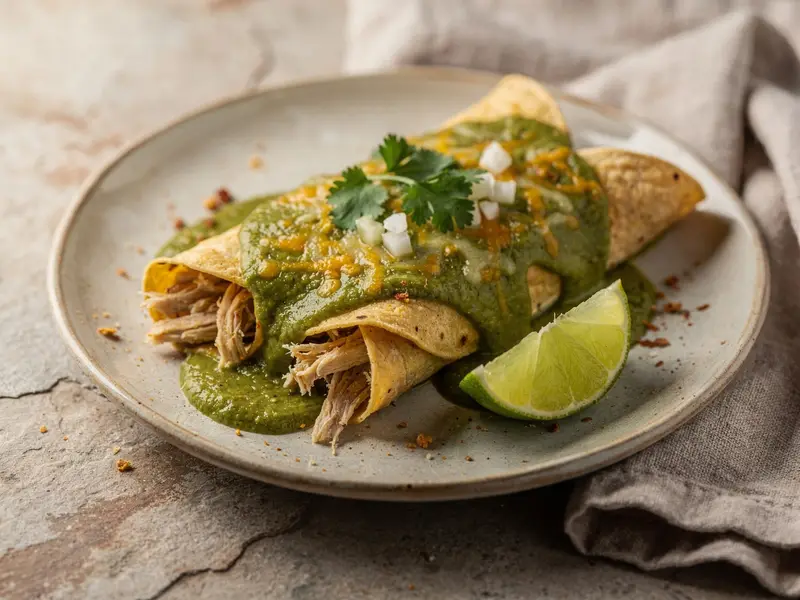
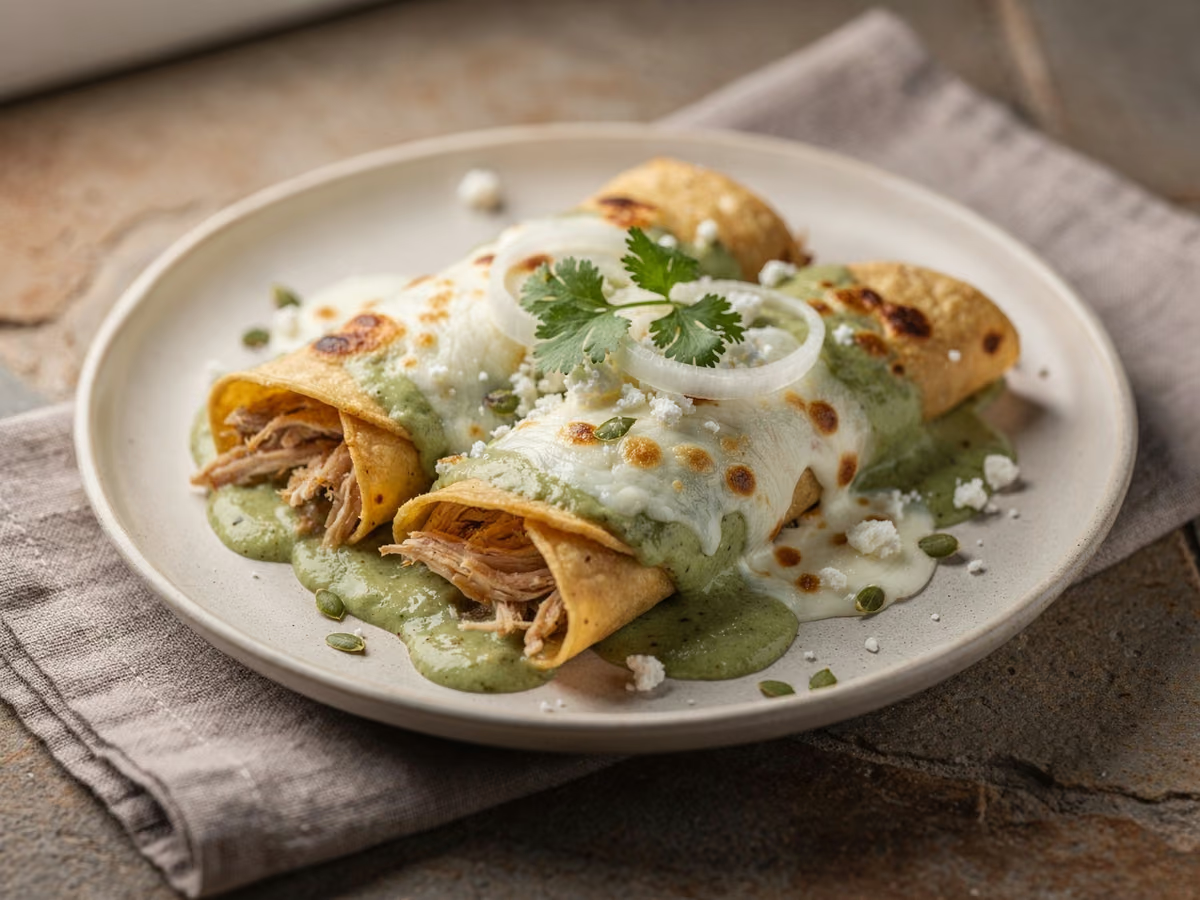
Enchiladas suizas are Mexico City's great comfort bake: corn tortillas rolled around shredded chicken, cloaked in a creamy roasted-tomatillo sauce, then gratinated under melted cheese until it bubbles. The 'suizas' nods to the cream and cheese that make the dish rich, and the story behind it belongs to the city's mid-century cafeterias. This version roasts the tomatillos and jalapeño until blistered, so the sauce tastes deep rather than raw, and the whole tray comes together in about fifty minutes — twenty-five minutes of prep and twenty-five in the oven.
- Prep
- 25 min
- Cook
- 25 min
- Total
- 50 min
- Serves
- 4
Ingredients
What you’ll need — tap to tick off as you go
- 500 g
- 3 cloves
- 2 tbsp
- 250 ml
- 120 ml
- 60 g
- 1 tsp
- 1 tsp
- 1 tsp
- ½ tsp
- 500 g
- 200 g
- 15 g
Process
Timers built in · swap anything · ask as you cook
Preheat the oven to 220°C and line a rimmed baking sheet with foil. Spread the 500 g tomatillos, the halved jalapeño, the onion quarters, and the three garlic cloves over the sheet, drizzle with 1 tbsp of the oil, and toss to coat. Keep them in a single layer: a crowded sheet steams the vegetables where a hot, dry oven blisters them.
Roast for 15 to 20 minutes, until the tomatillos soften, their skins blister and blacken in spots, and they release their juices; the onion edges and garlic should be lightly browned. Let the tray stand for a few minutes so the vegetables cool before they meet the cream.
Scrape the roasted vegetables and every drop of their juices into a blender. Add the 250 ml chicken broth, 120 ml heavy cream, 60 g sour cream, 1 tsp ground cumin, 1 tsp dried oregano (Mexican oregano if you have it), 1 tsp salt, and 0.5 tsp black pepper. Blend until completely smooth, about a minute, then taste and adjust the salt.
Pour the sauce into a medium saucepan over medium heat and bring it to a gentle simmer, then drop the heat to low and cook for 5 minutes, stirring occasionally, until slightly thickened. The sauce is ready when it coats the back of a spoon but still pours; the simmer cooks off the raw, vegetal edge of the blended tomatillos. Keep it warm over low heat.
Heat the remaining 1 tbsp oil in a small skillet over medium heat. Working one at a time, fry the 12 corn tortillas for about 10 seconds per side, until pliable and glossy but not crisp, then drain on paper towels. This flash-fry is what lets them roll without cracking and hold up under sauce in the oven.
Spread 1 cup of the warm sauce across the bottom of a 23 x 33 cm baking dish. Fill each softened tortilla with about 3 tbsp of the shredded chicken and a pinch of the Monterey Jack, roll it up tightly, and set it seam-side down in the dish, packing the rolls snugly so they cannot unroll.
Pour the remaining sauce evenly over the rolls, making sure the ends are covered — bare tortilla edges dry out and crack in the oven — then scatter the rest of the Monterey Jack over the top so every roll gets its share of the melted crust.
Bake for 15 to 20 minutes, until the cheese is melted and bubbly and the sauce bubbles at the edges of the dish. For a golden top, broil for 1 to 2 minutes, watching closely, since the tomatillos' sugars brown fast. The filling should be piping hot — 74°C at the center if you check with a thermometer.
Let the dish rest for 5 minutes before serving: the sauce settles and thickens, and the rolls firm up enough to lift cleanly. Garnish with the chopped cilantro and the thinly sliced red onion, and pass extra sour cream at the table.
Why this recipe works
Roasting the vegetables at 220°C does two jobs. The dry heat blisters the tomatillos until their skins blacken and their sugars caramelize, turning some of their sharp, raw acidity into a rounder, sweeter flavor; the same heat softens the onion and garlic and tames the jalapeño before the blender. Blending the roasted vegetables with broth, cream, and sour cream turns that flavor into a sauce thick enough to coat a spoon, and five minutes of simmering cooks off its raw edge. Briefly frying the tortillas is structural, not decorative: hot oil drives water out of the corn, and the oil that replaces it makes each round pliable and water-resistant, so the rolls hold together under the sauce.
Equipment
- Rimmed baking sheet, about 30 x 40 cm, lined with foil
- Blender, for a completely smooth sauce
- Small skillet, for softening the tortillas
- Medium saucepan, for simmering the sauce
- 23 x 33 cm baking dish, about 5 cm deep
- Tongs, for turning the roasted vegetables and the tortillas
- Instant-read thermometer, for the 74°C doneness check
- Measuring cups and spoons
Kitchen notes
Kitchen notes
- Shred the chicken while it is still warm and mix in two spoonfuls of the sauce before rolling; the filling then carries the sauce's flavor into the center of every tortilla instead of tasting plain against it.
- Buy a block of Monterey Jack and shred it yourself. The bagged shreds are dusted with starch so they stay loose on the shelf, and that starch is exactly what keeps them from melting into a smooth, stringy blanket.
- Taste the sauce twice — once in the blender and once after the simmer. Tomatillos vary wildly in acidity from batch to batch, and the second taste is your last chance to add salt, a pinch of sugar, or a splash of broth before the tray is assembled.
- Keep the softened tortillas wrapped in a clean towel as you work. They stiffen as they cool, and a warm tortilla rolls around the filling without a fight; by the last few rolls the difference is unmistakable.
- Make the sauce up to two days ahead and refrigerate it. Its flavor deepens overnight, and a cooled sauce tastes more honestly — corrections you make on day two will hold in the final dish.
- Watch the broiler like a hawk, and keep the dish on the middle rack rather than directly under the element. The broiler takes cheese from golden to black in well under a minute, and there is no way back.
Common mistakes
- Tortillas that crack and split as you roll — cold or dried-out corn is brittle, and older tortillas crack worst — fry each one about 10 seconds per side in the hot oil until it turns pliable, and roll while it is still warm.
- A dry, leathery bake — the oven runs long or sauce never reaches the tortilla ends — spread the full 1 cup across the bottom of the dish, pour the rest over the top so every roll is cloaked, and pull the bake at 15 to 20 minutes, as soon as the sauce bubbles.
- A soggy, collapsed tray — the sauce went in watery or the dish baked under cover — simmer the blended sauce until it coats a spoon before assembling, and bake it uncovered so the sauce tightens around the rolls instead of soaking in.
- A sharp, one-note sauce — tomatillos that never blistered keep their raw, aggressive acidity — roast them until the skins blacken and the fruit collapses, then taste; a pinch of sugar and a little more salt round off the edge without hiding the tomatillo.
- Filling that spills or pokes through — overstuffed rolls burst along the seam — stop at about 3 tbsp of chicken and a pinch of cheese per tortilla, and roll tightly so the seam sits flat against the dish.
- Pale, gummy cheese instead of a golden crust — a shy hand with the broiler — let the cheese melt through in the bake first, then finish for 1 to 2 minutes under the broiler, watching, because the top goes from golden to scorched quickly.
Serving suggestions
- Plate two or three rolls per person and spoon the warm sauce from the dish over each serving, so every plate gets its share of the sauce and the cheese crust.
- Mexican rice and refried beans turn the tray into a full comida; keep both mild so the creamy tomatillo sauce stays the loudest thing on the table.
- A bright, crunchy side cuts the richness: pickled jalapeños, a thin cabbage slaw, or sliced radishes, with lime wedges on the side.
- Serve straight from the oven, after the 5-minute rest, with extra sour cream, cilantro, and red onion at the table so everyone can finish their own plate.
Variations
- Meatless tray: replace the chicken with about 500 g of roasted carrots, zucchini, and cauliflower, cooked on a second sheet while the sauce vegetables roast; the creamy tomatillo sauce carries the vegetables beautifully.
- Extra heat: leave the jalapeño seeds in the blender or add a serrano chile alongside it. The dairy softens the burn but does not erase it, so taste the sauce before assembling.
- Rotisserie shortcut: a store-bought rotisserie chicken yields roughly the 500 g of shredded meat the recipe calls for, trimming the prep down to the sauce alone.
Refrigerator
- RefrigeratorCool the dish, then refrigerate it within 2 hours, covered. Leftovers keep for 3 to 4 days; the sauce thickens and the tortillas soften further overnight, which many people consider an improvement.
- ReheatingReheat single portions in the microwave on medium power, or the whole dish covered with foil in a 180°C oven for 10 to 15 minutes, until steaming hot throughout — 74°C by the USDA rule for leftovers. A spoonful of extra sauce or broth alongside keeps the tortillas from drying out.
- FreezingThe sauce alone freezes beautifully for up to 3 months; thaw it overnight in the refrigerator and reheat gently. An assembled, unbaked tray can be frozen too — thaw overnight and add a few extra minutes to the bake — but fully baked enchiladas suizas come back with softer tortillas and a looser sauce, so they are the least rewarding to freeze.
- Make aheadMake the sauce up to 2 days ahead and refrigerate it, and cook and shred the chicken at the same time to keep it separate. Assemble the tray just before baking, or up to a few hours ahead, covered in the refrigerator.
Updated:
How this recipe was developed
- USDA FSIS, Safe Minimum Internal Temperature Chart and Leftovers and Food Safety (poultry cooked to 74°C; leftovers refrigerated within 2 hours, kept 3 to 4 days, and reheated to 74°C)
- Larousse Cocina, enchiladas suizas entry (the cream in the sauce is what makes the dish unique; its name nods to Switzerland's dairy tradition)
- America's Test Kitchen, How to Make Mexico City's Bright, Rich, and Creamy Enchiladas Suizas (why briefly frying corn tortillas works — hot oil drives off water, the tortilla firms up and gains a water-resistant barrier — and the Sanborns department-store story)
- México Desconocido, Enchiladas suizas, ¿por qué este platillo mexicano se llama así? (created in Mexico City in the mid-twentieth century at Sanborns; the name nods to the generous cream and gratinated cheese)
Editorial references are kept internally for verification. This page makes no claim of external certification or professional testing.
FAQ
The questions we get asked most
What are enchiladas suizas?
Enchiladas suizas are corn tortillas rolled around shredded chicken and baked under a creamy roasted-tomatillo sauce, then gratinated with melted cheese and finished with cilantro and red onion. Two things define them: the sauce is enriched with cream and sour cream, and the top is baked to a golden, bubbling crust. The dish is a Mexico City classic, takes about fifty minutes from start to serve, and is mild enough for the whole table.
Why are enchiladas suizas called Swiss if they are Mexican?
They were invented in Mexico City, and the story is told two ways: one tradition credits a Mexico City restaurant tied to the household of Emperor Maximilian, and the other credits the Sanborns department-store cafe in the mid-twentieth century. The 'Swiss' part is a dairy compliment. The sauce carries cream and sour cream, the top is a blanket of melted cheese, and the Mexico of that era associated cooking this rich with Switzerland. The dish is Mexican by birth and Swiss only by richness.
What is the difference between enchiladas suizas and enchiladas verdes?
They begin from the same green tomatillo base, and the cream is the dividing line. Enchiladas verdes keep the sauce lean — tomatillos, chile, onion, herbs — and taste sharp, bright, and herbal, with the cheese often crumbled fresh over the top. In enchiladas suizas, cream and sour cream are blended into the sauce, which rounds off the tomatillos' acidity and turns the plate velvety, and the cheese is gratinated until golden. If you know one and not the other, the suizas version is the richer, milder side of the family.
What is enchiladas suizas sauce made of?
It is a roasted tomatillo sauce enriched with dairy. The 500 g of tomatillos, a jalapeño, a white onion, and three garlic cloves roast until blistered, then go into the blender with 250 ml chicken broth, 120 ml heavy cream, 60 g sour cream, cumin, oregano, salt, and black pepper. A short simmer thickens it to the consistency of light cream, so it coats a spoon but still pours. That cream-and-chile combination is the whole identity of the dish.
Are enchiladas suizas spicy?
They are mild to medium. The only heat comes from the jalapeño, and the cream, sour cream, and cheese soften it further; as written, one jalapeño gives gentle warmth. Scrape out its seeds and membranes before roasting for a barely-there burn, or leave them in and add a second chile for more. Because the dairy is blended into the sauce rather than served alongside, you cannot dial the heat back at the table, so taste before you assemble and blend in more cream if it runs hot.
How do I keep the corn tortillas from cracking when rolling enchiladas suizas?
Soften them first and keep them warm. Ten seconds per side in hot oil makes each tortilla pliable and gives it a water-resistant coat, so it rolls around the filling without splitting; stack the finished ones under a clean towel so they stay supple. Fresher tortillas crack least — older, drier ones need the full fry rather than a quick dip. If one does split, lay it in the dish anyway and cover it completely with sauce; the crack disappears under the cheese.
Why did my enchiladas suizas turn out dry?
Dryness almost always comes from too little sauce or too long in the oven. Use the whole batch of sauce: spread 1 cup across the bottom of the dish and pour the rest over the top, leaving no tortilla edge bare, because exposed corn dries and cracks. Then trust the cues rather than the clock — 15 to 20 minutes, until the sauce bubbles at the edges and the cheese is melted, is enough, since the filling is already cooked. The 5-minute rest before serving lets the sauce settle back into the rolls.
Ask KitchenMind about this recipe
Tell it what’s different tonight — it works within the actual recipe.