- Prep
- 30 min
- Cook
- 25 min
- Total
- 55 min
- Serves
- 8
Ingredients
What you’ll need — tap to tick off as you go
- 500 g
- 360 ml
- 7 g
- 9 g
- 5 ml
Process
Timers built in · swap anything · ask as you cook
In a large bowl, whisk 500 g bread flour with 7 g instant yeast and 9 g fine salt. Pour in 360 ml lukewarm water and mix with a wooden spoon or your hand until no dry flour remains. The dough will be sticky and shaggy.
Cover the bowl and rest the dough for 20 minutes, then perform a set of stretch-and-folds: wet your hand, lift one side of the dough, stretch it upward and fold it over the center. Repeat around the bowl 8 times. Rest 20 minutes and repeat the folds twice more.
Lightly grease a clean bowl with 5 ml olive oil, place the dough inside, cover and refrigerate for 12 to 18 hours. The dough should roughly double and smell slightly yeasty and sweet.
Scrape the cold dough onto a lightly floured counter. Divide it into 3 equal pieces, about 290 g each, using a bench scraper. Gently pat each piece into a rough rectangle, fold the long sides to the center and roll into a loose log. Cover and rest 20 minutes.
Shape each log into a baguette: flatten it lightly, fold the top edge down to the middle and press with your fingertips, repeat with the bottom edge, then fold in half and seal with the heel of your hand. Roll the log gently back and forth with cupped hands until it is about 35 cm long and tapered at both ends.
Place the shaped loaves seam-side down on a floured couche or parchment-lined baking tray, leaving space between them. Cover with a towel and proof at room temperature for 45 to 60 minutes, until a finger pressed into the dough leaves a slow, shallow dent.
Heat the oven to 240°C with a baking stone or an inverted heavy tray on the middle rack and a metal pan on the bottom rack. Boil 250 ml water for steam.
Just before baking, dust the loaves with flour and score each one with 3 to 4 quick, shallow slashes at a 30-degree angle using a sharp blade or lame.
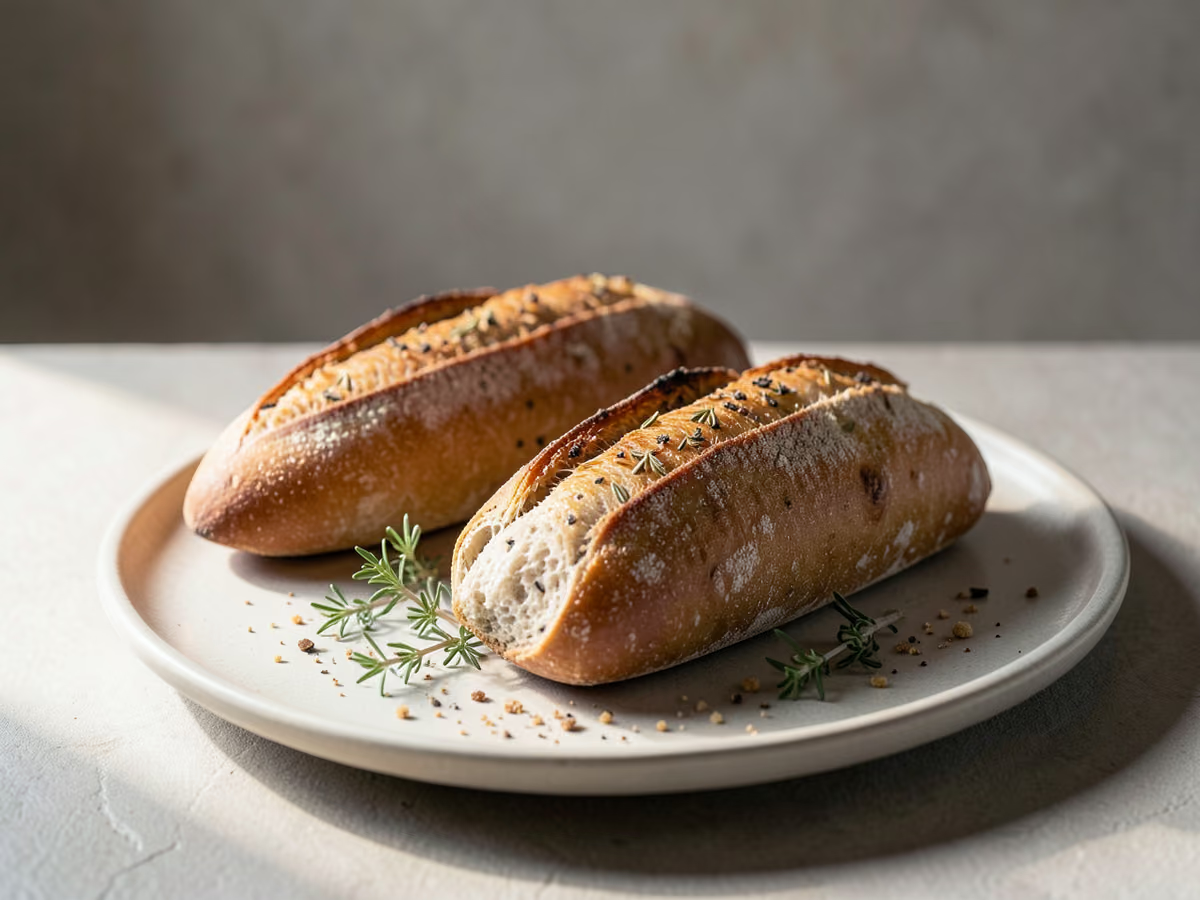
Slide the loaves onto the hot stone or tray, pour the boiling water into the bottom pan and close the oven door immediately. Bake 12 minutes, then remove the steam pan and bake 10 to 13 minutes more, until the crust is deep golden brown and the loaves sound hollow when tapped on the base.
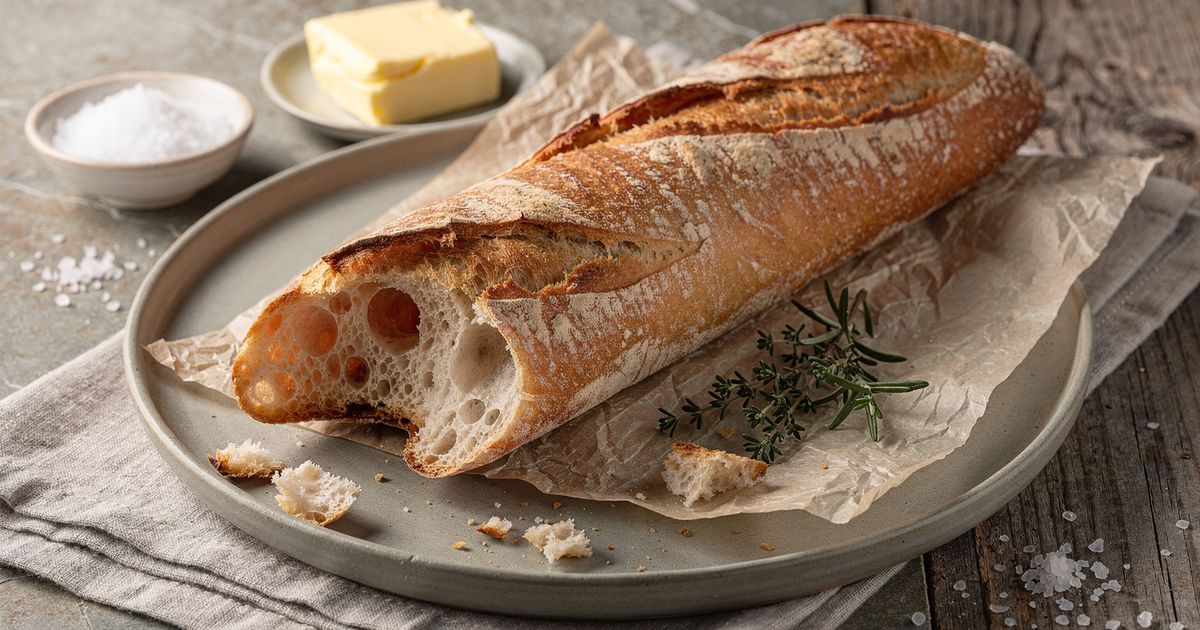
Cool the baguettes on a wire rack for at least 20 minutes before slicing so the crumb sets.
Kitchen notes
Kitchen notes
- The most common mistake is adding too much flour while shaping. Keep the dough slightly tacky; a wetter dough gives the open, airy crumb that defines a baguette.
- Steam during the first 12 minutes is what creates a thin, blistered crust. If you skip it, the crust will be dull and thick.
- Score the loaves immediately before they go into the oven, not earlier. The slashes open the dough and control where it expands.
- If your oven runs hot, drop the temperature to 230°C after the steam phase to avoid burning the crust before the center cooks.
Substitutions
- bread flour→all-purpose flour (slightly less chewy crumb)
- instant yeast→active dry yeast, same weight, proofed in the water first
- olive oil→any neutral oil for greasing the bowl
Storage & reheating
Keep baguettes at room temperature in a paper bag for up to 1 day; plastic makes the crust soft. For longer storage, slice and freeze in a zip-top bag for up to 2 months. Reheat frozen or day-old loaves at 200°C for 5 to 7 minutes directly on the rack, or refresh a whole loaf at 180°C for 8 minutes to crisp the crust.
FAQ
The questions we get asked most
Why did my baguettes turn out flat and dense?
The dough was likely over-proofed or the yeast was old. Cold-retarding for 12 to 18 hours develops flavor but the dough must still spring back slowly when poked. If it collapses when you touch it, it has gone too far; reshape and proof again briefly.
Can I make the dough ahead and bake later?
Yes. The cold rise can last up to 24 hours in the fridge. Shape the loaves, then refrigerate them on a floured tray for up to 8 hours; bake straight from cold, adding 2 to 3 minutes to the baking time.
How do I get a crisp crust without a baking stone?
Preheat a heavy baking tray upside down and bake the loaves on it. Put a metal pan of boiling water on the bottom rack for the first 12 minutes. The steam plus direct heat gives a crust almost as good as a stone.
Why did my slashes not open in the oven?
The blade was dull or the cut was too deep and dragged. Use a razor or very sharp knife, hold it at a shallow 30-degree angle and make one quick, confident slash about 6 mm deep. Score just before baking, never in advance.
Can I use whole wheat flour for this recipe?
Replace up to 100 g of the bread flour with whole wheat flour and add 15 ml extra water. Whole wheat absorbs more liquid and produces a denser loaf, so keep the rest as bread flour for structure.
How do I know when the baguettes are fully baked?
The crust should be deep golden brown and the loaf should sound hollow when tapped on the bottom. An instant-read thermometer inserted into the center should read about 96°C. If it reads lower, bake 3 more minutes.
Why is my baguette crust soft after cooling?
Trapped steam softens the crust. Cool the loaves on a wire rack with space between them, never on a solid surface or under a towel. If the crust softens later, reheat at 200°C for 5 minutes to re-crisp it.
Ask KitchenMind about this recipe
Tell it what’s different tonight — it works within the actual recipe.