Chicken Kiev
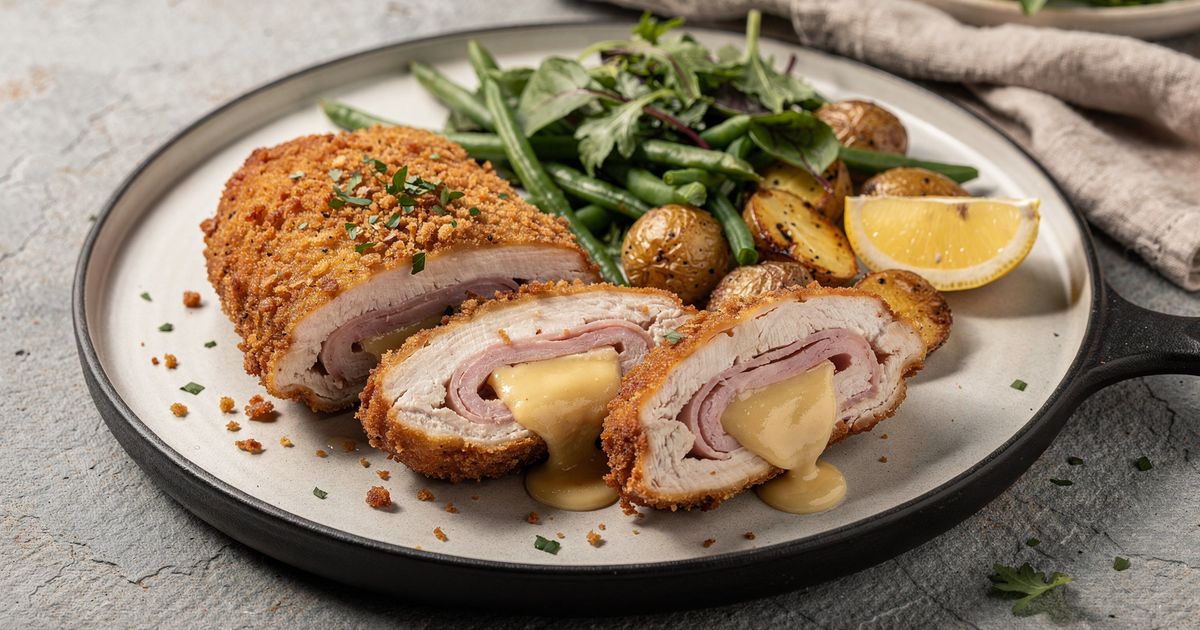
Chicken Kiev turns a pounded chicken breast into a sealed parcel of garlic butter: rolled tight, double-coated in flour, egg and panko, then shallow-fried until the crust shatters and the buttery centre spills across the plate. The version here uses four 200 g breasts, a 120 g garlic-herb butter sharpened with lemon and dill, and a 175°C shallow fry that cooks the coating and the meat at the same rate. Active work is about 30 minutes; frying and resting take another 20, with roughly 35 minutes of hands-off chilling around them.
- Prep
- 30 min
- Cook
- 20 min
- Total
- 70 min
- Additional time
- 20 min
- Serves
- 4
Ingredients
What you’ll need — tap to tick off as you go
- 120 g
- 3 cloves
- 3 tbsp
- 1 tbsp
- 1 tsp
- 1 tsp
- ½ tsp
- 60 g
- 120 g
- 500 ml
Process
Timers built in · swap anything · ask as you cook
Mash the 120 g softened unsalted butter with the 3 minced garlic cloves, 3 tbsp chopped parsley, 1 tbsp chopped dill, 1 tsp lemon juice, 1/4 tsp of the salt and a pinch of the black pepper until evenly combined. Shape into an 8 cm log, wrap tightly in plastic wrap and freeze for at least 20 minutes until firm. A hard log is what keeps the filling sealed later.
Place each of the 4 chicken breasts between two sheets of plastic wrap and pound with a meat mallet or rolling pin to an even 5 mm thickness, working from the centre outwards without tearing the meat. Season both sides with the remaining 3/4 tsp salt and the rest of the 1/2 tsp black pepper.
Cut the frozen butter log into 4 equal pieces. Set one piece in the centre of each pounded breast, fold the long sides over the butter, then roll up tightly from the short end into a compact parcel. Press the seam closed and secure with toothpicks if the roll wants to open; sealed edges are the only thing keeping the butter away from the oil.
Set up three shallow dishes: the 60 g flour, the 2 eggs beaten with 1 tbsp water, and the 120 g panko. Roll each parcel first in flour and shake off the excess, then dip it in the egg, then press it into the panko until fully covered, patting gently so the crumbs grip. Bald patches are where leaks begin.
Dip each coated roll a second time in the egg and panko, pressing the second layer on firmly so the double coat acts as a seal. Chill the rolls on a plate in the refrigerator for 15 minutes so the coating sets before it meets the oil.
Pour the 500 ml vegetable oil into a large deep skillet to a depth of about 2 cm and heat over medium-high until a dropped breadcrumb sizzles immediately, about 175°C. Lower 2 rolls in gently and fry for 4–5 minutes per side, turning with tongs, until deeply golden. Keep the oil at 175°C: hotter and the crust darkens before the centre cooks, cooler and the coating drinks oil.
Move the first 2 rolls to a wire rack set over a baking sheet, then fry the remaining 2 the same way, letting the oil come back to 175°C first. Drain on the rack rather than paper towels, so steam can escape and the undersides stay crisp.
Rest the rolls for 3 minutes before serving. The filling is molten and much hotter than the meat, so cut the first roll open at the table and let the butter run over the plate; the crust also firms as it cools, which keeps it crisp against the knife.
Why this recipe works
Frozen butter is the architecture of the dish: a solid log cuts into clean discs that sit inside the rolled breast without smearing into the seam, and it stays contained through the first minutes of frying while the coating sets. Pounding to an even 5 mm matters for the same reason — an even sheet rolls without thick folds, and folds are where leaks start. The double coat builds a two-layer armour of flour, egg and panko, and the 15-minute chill firms it so the crumb does not slough off on contact with the oil. Hold the oil at 175°C and the crust browns in roughly the same window the meat needs to reach 75°C.
Equipment
- Small bowl for the garlic-herb butter
- Plastic wrap for rolling and pounding
- Meat mallet or rolling pin
- Three shallow dishes or plates for the flour, egg and panko
- Large deep skillet, about 28 cm, to hold 2 cm of oil
- Instant-read thermometer for the oil and the chicken
- Wire rack set over a baking sheet
- Toothpicks for securing the rolls
Kitchen notes
Kitchen notes
- Make the garlic butter ahead and keep a wrapped log on hand: frozen from solid wraps far more cleanly than one chilled for twenty minutes, so a spare log is the difference between clean discs and buttery fingers.
- Roll the breast using the plastic wrap it was pounded on as a guide, lifting the edge of the wrap to start the roll; the wrap keeps the seam tight without stretching the meat with your hands.
- Check the chicken's temperature by inserting the probe through the end of the roll, partway into the meat only: a probe pushed through the side can open a hole and give the butter an exit.
- If a seam does split while wrapping, patch the hole with a scrap of raw chicken pressed over it; the patch bonds during frying and saves the parcel.
- Serve within a few minutes of resting. Held longer, the crust steams soft from the inside and the filling cools back towards solid, which loses the whole point of the dish.
Common mistakes
- Butter leaks into the pan: the log was not frozen hard enough, or the parcel was not sealed tightly. Freeze it for the full 20 minutes until solid, fold the sides in first, roll tight, and press the seam and ends closed before the roll meets the oil.
- The coating splits and slides off: a warm or damp roll hitting the pan. Pat the surface dry, press the panko on firmly in two layers, and chill the coated rolls for the full 15 minutes so the shell sets.
- The crust turns deep brown before the chicken is done: the oil ran hotter than 175°C. Fry at 175°C and pull the rolls when the centre reads 75°C, a touch above the 74°C USDA FSIS minimum for poultry.
- The oil cools and the coating turns greasy: too many rolls fried at once. Fry 2 at a time and let the oil come back to 175°C between batches; a breadcrumb dropped in should sizzle immediately.
- Dry, stringy meat: thin patches in the pounded breast overcook in the time the thicker areas need. Pound every breast to a consistent 5 mm and keep the oil steady so the crust and the interior finish together.
Serving suggestions
- Plate one roll per person and cut it open at the table so the garlic butter runs over the plate rather than onto the board.
- Mashed potatoes or buttered new potatoes are the traditional landing place, because they are made to soak up the butter; plain rice works the same way.
- A sharp green salad or steamed broccoli with lemon cuts the richness, and keep the dressing simple and acidic.
- A squeeze of lemon over the crust just before eating sharpens the herbs in the filling; add it at the table, not before serving.
Variations
- Pocket method: instead of pounding and rolling, cut a deep horizontal pocket into each breast from the fat end, tuck two thin butter discs inside and press the opening closed. It is quicker and neater, and the butter is a little less protected, so keep the oil at 175°C and do not crowd the pan.
- Baked version: fry nothing at all; set the coated rolls on a wire rack over a baking sheet and bake at 200°C for 20-25 minutes, until golden and cooked through. The crust is crisper if the panko is tossed with a little oil and toasted first, and the butter still melts inside.
- Party-size kievs: cut 2 breasts in half crosswise to make 8 smaller parcels with 8 smaller butter pieces, and fry for 3-4 minutes per side; smaller parcels cook faster but obey the same sealing and chilling rules.
Refrigerator
- RefrigeratorCool any leftovers, then refrigerate in an airtight container for up to 3 days; cooked poultry keeps 3 to 4 days by USDA guidance, but the crust softens quickly, so plan to reheat it.
- ReheatingReheat on a wire rack over a baking sheet at 180°C for 10-12 minutes, until the crumb re-crisps and the centre is hot throughout (74°C, the USDA FSIS reheat minimum). Do not microwave it: the coating steams soft and the filling can turn greasy.
- FreezingNot recommended for fried leftovers, because the coating and the filling both suffer on thawing. If you want a freezer stash, freeze the uncooked, coated rolls on a tray on the day you make them, then bag them, for up to 3 months, and fry from frozen with a minute or two extra per side (the freeze-ahead approach used by classic versions of the dish).
- Make aheadThe garlic butter can be made and frozen well ahead, and the assembled rolls can be breaded, covered and refrigerated up to 24 hours before frying; fry them straight from the fridge. Beyond a day the coating starts drawing moisture and the crumb loses its grip.
Updated:
How this recipe was developed
- USDA FSIS safe minimum internal temperatures and reheat guidance (poultry and leftovers: 74°C / 165°F)
- FoodSafety.gov cold food storage chart (cooked poultry keeps 3 to 4 days refrigerated)
- BBC Good Food, chicken kyivs (double coating, chilling before frying, and freeze-ahead guidance)
- RecipeTin Eats, chicken kiev (partially freezing the wrapped rolls so the seams stay sealed; probing through the end to avoid a butter exit hole)
Editorial references are kept internally for verification. This page makes no claim of external certification or professional testing.
FAQ
The questions we get asked most
Why did my chicken kiev leak butter in the pan?
The butter was not frozen solid enough, or the parcel was not sealed tightly before it hit the oil. Freeze the log for the full 20 minutes until hard, fold the sides in first and roll very tight, press the seam closed, and give the rolls both coats of egg and panko plus the 15-minute chill. If a seam splits while you wrap, patch it with a scrap of raw chicken pressed over the hole; the patch bonds in the pan.
How do I know when chicken kiev is cooked through?
The reliable test is an instant-read thermometer: 75°C in the thickest part of the meat, a notch above the 74°C USDA FSIS safe minimum for poultry. Insert the probe through the end of the roll, partway in, so you do not open a channel for the butter. The crust should be deep golden and the meat white and opaque; juices running clear is a secondary cue that is easy to over-read.
Can I prepare chicken kiev ahead of time?
Yes. The garlic butter log can be made and frozen well ahead, and breaded, uncooked rolls keep covered in the fridge for up to 24 hours; fry them straight from the fridge without bringing them to room temperature. Longer than a day, the coating starts to draw moisture and loses its grip.
Can I bake chicken kiev instead of frying it?
Yes, though the crust will not shatter the way a fried one does. Set the coated rolls on a wire rack over a baking sheet and bake at 200°C for 20-25 minutes, until golden and cooked to 75°C at the centre. The butter still melts inside; for a crisper baked shell, toast the panko with a little oil and cool it before coating.
Can I make chicken kiev with chicken thighs?
Not with the same method. A thigh does not pound into a large enough sheet to wrap a quarter of the butter log without overlapping two pieces, which makes the parcel hard to seal and prone to leaking. Breast is the cut that reliably rolls, which is why the recipe is built around four 200 g breasts.
Can I freeze chicken kiev?
The uncooked, coated rolls freeze well: freeze them on a tray on the day you make them, then bag them for up to 3 months and fry from frozen, adding a minute or two per side. Fried leftovers do not freeze well, because the coating and the filling both degrade on thawing; reheat those from the fridge instead.
Can I use dried herbs instead of the fresh parsley and dill?
Dried herbs work at about a third of the fresh volume: roughly 1 tbsp dried parsley and 1 tsp dried dill stand in for the 3 tbsp and 1 tbsp of fresh. The filling will be duller and dustier than the fresh version, so this is a pantry-day compromise rather than an equal swap.
Ask KitchenMind about this recipe
Tell it what’s different tonight — it works within the actual recipe.