Tomato Basil Frittata
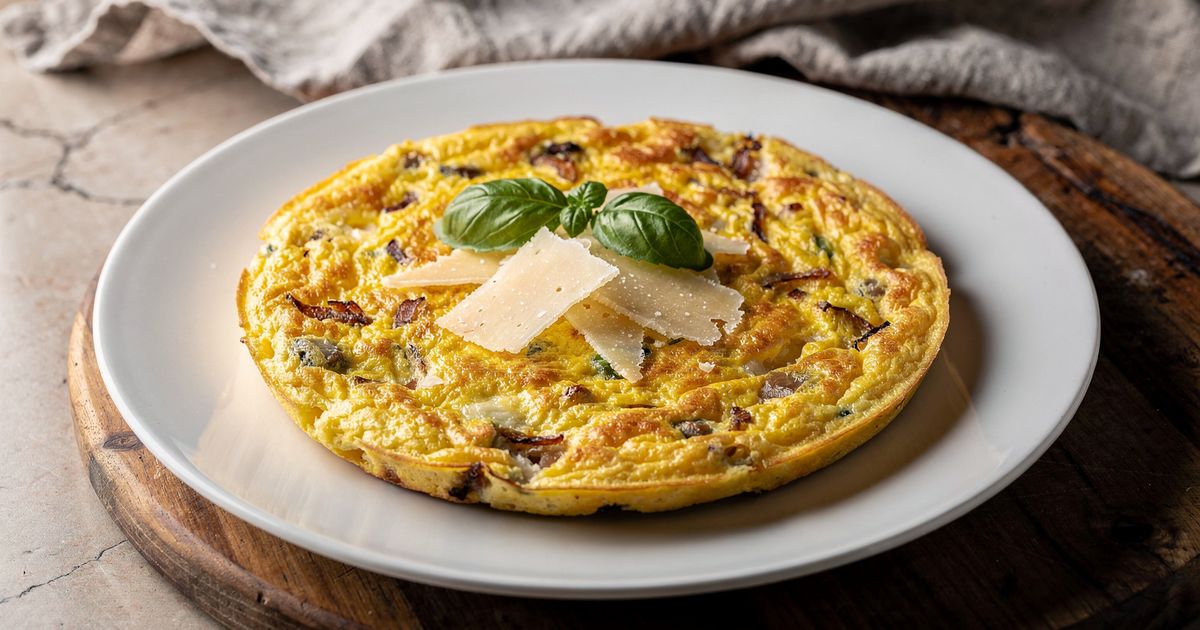
Tomato basil frittata is the Italian answer to a crustless quiche: six eggs set gently over sweet onion and softened tomatoes, finished with parmesan and a whole bunch of basil. It cooks entirely on the stovetop in a covered pan, so there is no oven to wait for and no flipping. Ten minutes of prep and about fifteen minutes in the pan get you a tender, sliceable frittata for three.
- Prep
- 10 min
- Cook
- 15 min
- Total
- 25 min
- Serves
- 3
Ingredients
What you’ll need — tap to tick off as you go
- 1 tbsp
- 40 g
- 1 bunch
- ½ tsp
- ¼ tsp
Process
Timers built in · swap anything · ask as you cook
Warm the 1 tbsp olive oil in a 24 cm nonstick skillet over medium heat, add the diced onion and cook for 4 minutes, stirring now and then, until it turns soft and translucent. Keep the heat at medium: onion that browns here tastes bitter and speckles the pale eggs.
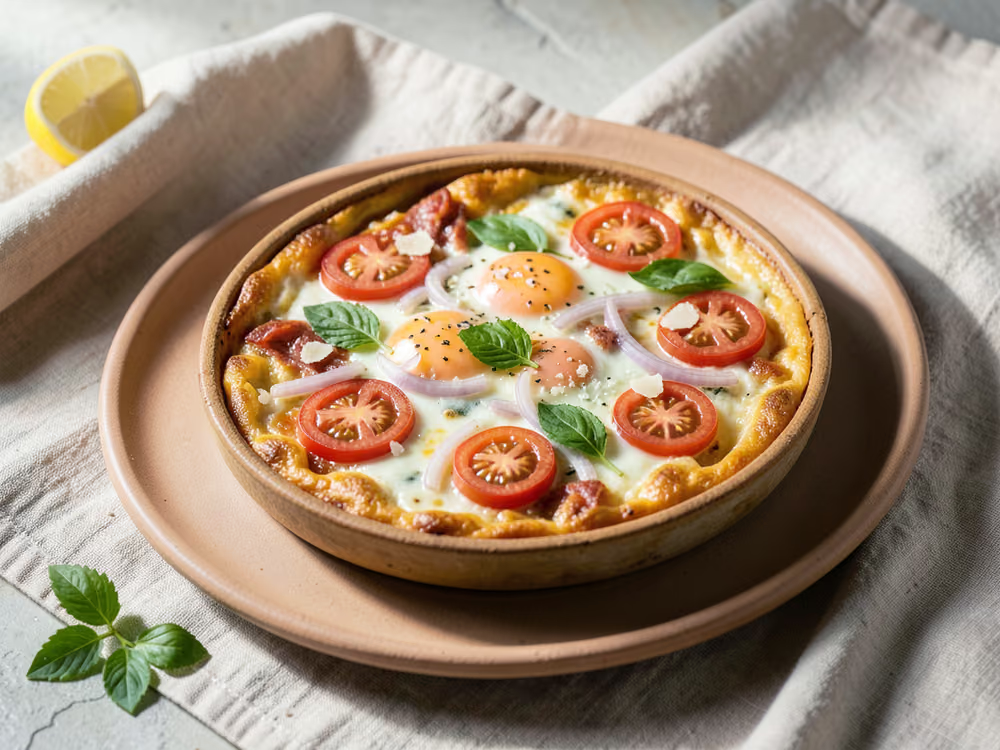
Halve the 3 tomatoes and lay them in the pan cut-side down. Cook for 3 minutes, until the cut faces soften and begin to release juice; if a pool of liquid builds up, give it another minute so that water cooks off rather than steaming the eggs later.
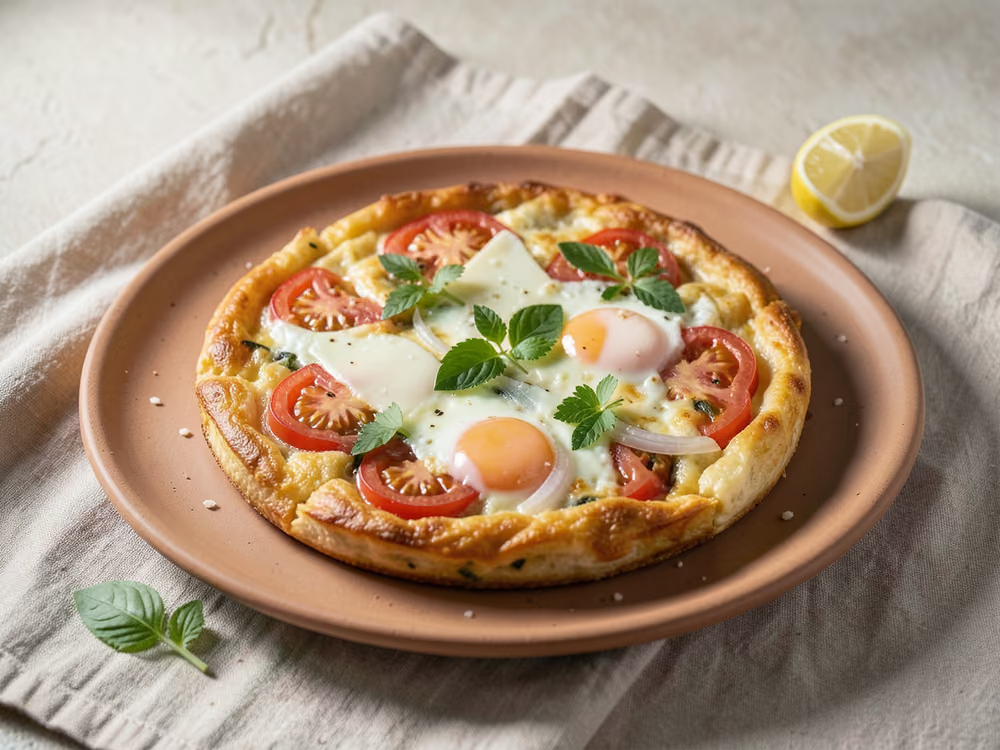
Beat the 6 eggs in a bowl with the 40 g grated parmesan, 1/2 tsp salt and 1/4 tsp black pepper until the yolks and whites are fully blended and only lightly frothy. Over-beating whips in air that bakes into dry, spongy pockets, so stop as soon as the mixture is uniform.
Pour the egg mixture over the tomatoes and tilt the pan so it settles into a flat layer, then reduce the heat to low. Leave it undisturbed for 2 to 3 minutes: the rim should turn opaque and firm while the centre is still loose.
Scatter the basil leaves over the top, cover the pan and cook for 5 minutes more, until the centre is just set. Lift the lid and check that no runny egg pools on the surface and that the middle springs back under a light touch; an instant-read thermometer at the centre should read 71°C, the safe-cooking point for egg dishes.
Run a heatproof spatula around the rim and under the frittata to loosen it, then slide it onto a board or warm plate. Cut into 6 wedges and serve warm; the wedges hold their shape once the eggs have had a minute off the heat.
Why this recipe works
The vegetables are cooked before the eggs arrive: tomatoes are mostly water, and juice that seeps into the egg mix steams instead of setting, so the onion and tomato halves soften in the pan first and their liquid cooks off. The eggs are beaten only until uniform, because extra air whips in foam that bakes into dry, spongy pockets. Low heat does the rest: egg proteins set into a delicate network as they warm, while strong heat tightens that network and squeezes water back out. Covering the pan traps steam so the top sets without a browned base, the parmesan salts the eggs from the inside, and the basil goes in last so it wilts rather than fries.
Equipment
- 24 cm (10-inch) nonstick skillet with a matching lid
- Mixing bowl
- Whisk or fork
- Fine side of a box grater, for the parmesan
- Heatproof flexible spatula
- Cutting board and chef's knife
- Serving board or large flat plate
- Instant-read thermometer (optional, for the 71°C centre check)
Kitchen notes
Kitchen notes
- Grate the parmesan finely so it disperses through the eggs instead of sinking to the base in one dense layer.
- If you are cooking for anyone at higher risk from runny eggs, check the centre with a thermometer before serving: 71°C is the point at which egg dishes are considered safely cooked, and this frittata should be right there when it leaves the pan.
- A frittata in a smaller pan will be thicker, and the centre needs longer under the lid; start checking at 6 or 7 minutes instead of 5.
- Slide the frittata onto a warm plate rather than a cold board if it will sit for a few minutes before serving; egg dishes cool quickly and taste best above room temperature.
- Keep a few leaves from the bunch back and tear them over the top just before serving to bring back the perfume that cooking mutes.
Common mistakes
- A watery frittata that will not set: tomatoes shed juice as they cook, and any pool left in the pan steams the eggs instead of letting them firm up. Cook the halves until their cut faces are dry, and if the pan still looks wet before the eggs go in, keep it over the heat for another minute.
- Rubbery, spongy eggs: too-high heat makes the egg proteins contract and squeeze out water. Cook over low heat with the pan covered, and bring the eggs off the heat as soon as the centre is just set.
- A raw top over a browned base: the lid went on late or the heat was too high when the eggs were poured. Keep the pan at low, let the rim set first, then cover so the trapped steam finishes the middle.
- The frittata sticks and tears as you slide it out: not enough oil for the base, or the rim was not loosened all the way around. Use the full 1 tbsp olive oil in a true nonstick pan and run the spatula right around the edge.
- Blackened, bitter basil: whole basil leaves added early fry against the hot pan. Scatter the bunch on top only in the final minutes and let the covered pan wilt it.
Serving suggestions
- Serve warm, not straight from the burner: a couple of minutes off the heat lets the wedges firm up enough to lift cleanly.
- Crusty bread and a simply dressed green salad with lemon make the classic Italian pairing.
- A spoonful of ricotta or a drizzle of good olive oil over each wedge adds creaminess without weighing the eggs down.
- Cut into smaller wedges and serve at room temperature as part of an antipasti spread, within two hours of cooking.
Variations
- Grill-finish version: once the rim has set, slip the pan under a hot grill for 2 to 3 minutes instead of covering it, until the top is set and golden; keep the handle out of the heat unless it is ovenproof.
- Feta version: swap the parmesan for 40 g of crumbled feta added with the eggs and cut the salt in half; feta brings a sharper, saltier edge and a slightly looser set.
- Dairy-free variation: leave out the parmesan, add 1/4 tsp extra salt and a drizzle of olive oil, and expect a slightly softer, flatter frittata.
Refrigerator
- RefrigeratorCool the frittata within 2 hours of cooking, then refrigerate it covered for up to 3 days. Cut leftovers into wedges and stack them with parchment between layers so they lift apart cleanly.
- ReheatingWarm wedges covered in a 160°C oven for 10 minutes, or microwave them on medium until hot through; FDA guidance for egg dishes is to reheat to 74°C.
- FreezingNot recommended: the egg sets spongy and weeps water when thawed. If you want to try, wrap individual wedges tightly, freeze them, and thaw overnight in the fridge, expecting a softer, wetter texture.
- Make aheadIt is at its best within an hour of leaving the pan, but a fully cooked frittata refrigerated the same day works well cold or reheated for up to 3 days. Prep the onion and grate the parmesan the night before to cut the morning work to 15 minutes.
Updated:
How this recipe was developed
- FDA, What You Need to Know About Egg Safety (egg dishes cooked to 71°C/160°F; refrigerated egg-dish leftovers used within 3 to 4 days; reheat to 74°C; never more than 2 hours at room temperature)
- BBC Food, 'Anything-goes frittata' (stovetop method: gentle heat for about 5 minutes until almost set, then finish; loosen and slide onto a board)
- Tasting Table, 'The Real Reason Your Frittata Turned Out Soggy' (uncooked high-moisture vegetables such as tomatoes seep water and must be cooked first)
- SELF, 'How to Make Great Frittatas' (cook fillings before adding eggs; drain tomato juice; extra liquid prevents the frittata setting)
Editorial references are kept internally for verification. This page makes no claim of external certification or professional testing.
Gallery
FAQ
The questions we get asked most
Why is my frittata watery?
Almost always the tomatoes. The three halves give off juice as they cook, and any puddle left in the pan steams the eggs rather than letting them set. Cook them cut-side down until the faces are dry, and if the pan still looks wet, reduce it for another minute before the eggs go in. Very juicy tomatoes can be drained cut-side down for a few minutes first.
How do I know when the frittata is done?
The centre should look barely set, with no loose egg pooling on the surface, and spring back under a light touch while the rim and base are firm and lightly golden. If you want certainty, an instant-read thermometer at the centre should read 71°C, the safe-cooking point for egg dishes.
Can I make a frittata ahead of time?
Yes. Cool it within 2 hours of cooking, refrigerate it covered, and reheat wedges to 74°C in a 160°C oven or the microwave. It keeps up to 3 days; it is at its most tender within a day, after which the texture firms slightly.
Can I freeze frittata?
Not recommended. The eggs turn spongy and release water when thawed, so a frozen-then-thawed frittata is wetter and grainier than one simply refrigerated. If you do freeze it, wrap wedges tightly and thaw overnight in the fridge.
Can I add other vegetables?
Yes, but treat them like the tomatoes: cook them first and drive off their water. Mushrooms, zucchini and spinach all release a lot of liquid and will undo the set if they go in raw, so saute or squeeze them before they join the pan. Keep the additions modest so the 6 eggs can still set around them.
Is this frittata vegetarian and gluten-free?
There is no gluten in it, so it is gluten-free as written. For a strictly vegetarian version, check the parmesan: traditional parmesan is set with animal rennet, so use a vegetarian-certified hard cheese. To make it dairy-free, leave the cheese out and add a pinch more salt.
Ask KitchenMind about this recipe
Tell it what’s different tonight — it works within the actual recipe.